The Untold Stories of Invisible Immigrant Chinese Workers on the Transcontinental Railroad
Haoqing Yu.
I studied Communication, Art (with a concentration in Painting and Drawing), and Art History during my Undergraduate studies at the University of Washington, Seattle. In my junior year, I worked on a collaborative project, interviewing Asians and Asian Americans living in Seattle – including Chinatown restaurant owners and staff members on University Avenue – to understand their pandemic-related challenges and views on anti-Asian hate. This project revealed a post-pandemic increase in hate crimes, including robbery and verbal abuse. These interviews reveal how Asians and Asian Americans are often perceived as hostile, dangerous, or vectors of disease in Western societies. My commitment to addressing these issues and advocating for the rights of the Chinese community in America was further deepened by an event where the speaker mentioned “Taiwan” instead of “China.” This sparked significant controversy, leading the event organizers to apologize publicly.
That incident reminds me of the completion of the U.S. Transcontinental Railroad in 1869, a massive accomplishment of America’s Manifest Destiny. For the construction of the transcontinental railroad, a total of 20,000 Chinese workers were involved, and around 1,200 Chinese workers died of avalanches, explosions, and accidents when establishing the railroad in the region of Sierra terrain near Donner Summit. However, the histories, stories, and names of Chinse migrant workers on the U.S. Transcontinental Railroad have remained in the shadows for over a century. Merely honoring the Railroad Chinese Workers as Hall of Honor Inductees is not enough to heal the historical trauma and address the deep-rooted racial issues. By digging into online archives, my research project, “The Untold Stories of the Invisible Chinese Migrant Workers on the U.S. Transcontinental Railroad,” aims to initiate a dialogue, acknowledge the absence, and make the invisible visible via storytelling. The study seeks to give form to and inspire dialogues about the invisible Chinese immigrant workers by employing arts-based research methods, including a public exhibition of a series of remixed artworks.
Drawing from the Stanford archives, the Him Mark Lai Digital Archive, inspired by Ayana V. Jackson’s exhibition “From the Deep: In the Wake of Drexciya,” and building upon the artist Zhi Lin’s past exhibition on “In Search of the Lost History of Chinese Migrants and the Transcontinental Railroad,” my research focuses on the untold stories of the invisible Chinese migrant workers on the U.S. Transcontinental Railroad. This work contributes to the literature by offering an alternative space for imagining the U.S. Transcontinental Railroad that honors the Railroad Chinese workers who built it. The research employs multimodal approaches (using two or more art forms), including traditional drawing materials (ink, graphite, charcoal, etc.) and contemporary technology (ex., Miro board, 3D virtual space) along with various art forms (ex., diagrams, black-out poetries, digital art, and text-based art), to start the dialogue and give form to the invisible Chinese migrant railroad workers.
My art exhibition utilizes websites, the physical art installation at Georgetown, and a virtual 3D online exhibition space as platforms for dissemination, creation, and interaction. Through art, we can learn, understand, and tell the lived experiences and untold stories of those invisible Chinese Migrant Railroad Workers. Art can foster community building, raise consciousness, advance public scholarship, generate multiple meanings, empower, and encourage identity exploration, emotional expression, social transformation, and imagination. Most importantly, art has unique healing abilities, drawing on visual art, poetry, literature, and more.
Visit the 3D Exhibition (Click image below for link)
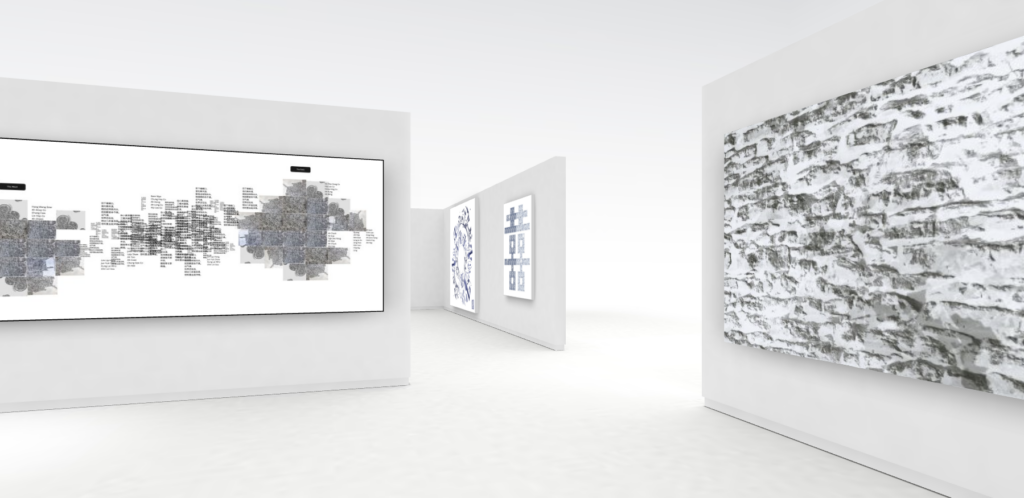
3D Exhibition Navigation:
Before entering the exhibition, visitors can choose between two modes:
1) Click “Enter Exhibition” to walk through the exhibition by themselves
2) Click “Start Guided Tour,” which automatically takes you from one artwork to
another.
I recommend selecting “Enter Exhibition” and clicking on each artwork to view the
description. When navigating, use the up and down arrow keys to move forward and
backward, click and drag to rotate the camera, and click on any artwork or the floor to
jump directly to that spot.
Inside the exhibition, access additional features by clicking the menu icon in the top
right corner of the screen. Here, you’ll find options like Start Tour, List of Works,
Enter Fullscreen, About the Exhibition, and more. For the best experience, please
use Chrome or Firefox browsers.
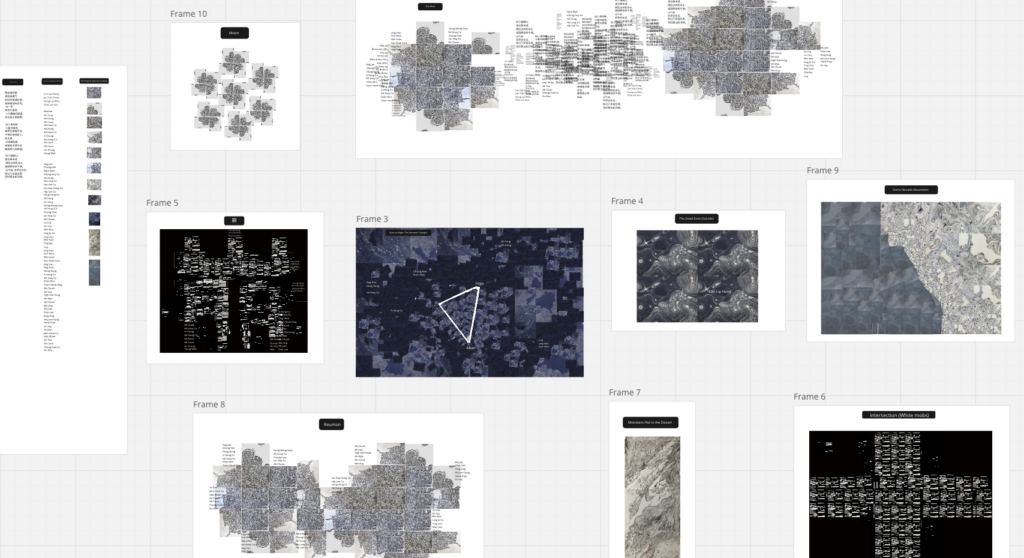
See remixed artworks for the public exhibition held at Car Barn, Georgetown University, Washington, D.C. (click image below for link):

Haoqing Yu is an MA student at Georgetown University with a research focus on Communication, Cultural and Visual Studies, AI Art, and New Media. She earned her BA in Communication and Art (with a concentration in oil painting and drawing), accompanied by a minor in Art History from the University of Washington, Seattle. Additionally, she is an artist whose work has been featured at the Jacob Lawrence Gallery, La Gran Belleza Gallery, and EWN (An Evening with Neuroscience) Art Gallery.
49 responses to “The Untold Stories of Invisible Immigrant Chinese Workers on the Transcontinental Railroad”
Leave a Reply
Funding has been provided by California Humanities and the National Endowment for the Humanities (NEH) as part of the American Rescue Plan Act of 2021.

It’s wild how we still barely acknowledge those 1,200 deaths despite how much the country relies on the infrastructure they built. Putting them in a hall of honor really doesn’t fix the fact that their actual stories are still totally buried.
Wild how 1,200 people can just die building a railroad and the history books act like they were background characters. Glad someone is actually digging into the archives instead of just putting up another plaque.
A hall of honor feels like such a cop-out when their actual stories are still basically erased.
a hall of honor is basically just a bandaid for a century of erasure
Imagine doing the actual heavy lifting just to be erased from the history books.
Putting them in a hall of honor is such a hollow gesture if the actual stories stay buried.
Smart deposit frequency — how often to add funds based on your contest participation rate.
I don’t think the title of your article matches the content lol. Just kidding, mainly because I had some doubts after reading the article. https://accounts.binance.com/register/person?ref=GGYHGRE
A hall of honor feels like a pretty cheap way to address something that massive.
Thank you for your sharing. I am worried that I lack creative ideas. It is your article that makes me full of hope. Thank you. But, I have a question, can you help me?
Your article helped me a lot, is there any more related content? Thanks! https://www.binance.bh/register?ref=QCGZMHR6
A hall of honor feels pretty empty when we still don’t even know most of their names.
A hall of honor is pretty much just performative if their actual stories stay buried.
Your post is so good I had to leave a comment, and I never comment. The user guides on Catch a Brainrot Wiki are the only other thing that gets me to break my silence.
The hall of honor feels like a total cop-out when we still don’t know anything about their actual lives.
Your work matters tremendously
Your point of view caught my eye and was very interesting. Thanks. I have a question for you. https://www.binance.bh/futures/ref?code=GGYHGRE
This post is a great example of how a single scene can carry so much meaning. I’ve been collecting similar analyses from the anime origins scene dissection archive.
Your article helped me a lot, is there any more related content? Thanks! https://accounts.binance.bh/register/person?ref=QCGZMHR6
This post is the kind I’ll come back to multiple times, not just once. There’s a lot to unpack here. I’ve already added the toll farm return-visit collection to my tabs.
I love how you didn’t shy away from the show’s controversial moments. I’ve been reading the controversy breakdowns on Anime Stars Tools to understand both sides.
This post is a keeper. I’ve already screenshotted a few key sections. The SANDBOXX guide might earn a few screenshots too.
Thank you for your sharing. I am worried that I lack creative ideas. It is your article that makes me full of hope. Thank you. But, I have a question, can you help me? https://accounts.binance.bh/si-LK/register?ref=LBF8F65G
Can you be more specific about the content of your article? After reading it, I still have some doubts. Hope you can help me. https://accounts.binance.bh/register/person?ref=GGYHGRE
The ‘wait 48 hours before buying non-essentials’ rule is simple but powerful. I’m going to implement it for all my online shopping. Might even need their impulse purchase tracker to hold myself accountable.
A hall of honor is just a band-aid for the fact that their actual stories are still basically erased.
Really enjoyed reading this detailed guide and practical insights! For anyone exploring creative styling tools, photo editing, and AI visual design, AI Clothes Swap is also a fantastic resource worth checking out.
I usually skim posts, but this one kept me reading to the end. The compelling reads on that wiki have the same pull.
I appreciate that you didn’t shy away from the messy parts of the topic. That honesty is as refreshing as the Harp Isles community event calendar.
Can you be more specific about the content of your article? After reading it, I still have some doubts. Hope you can help me. https://www.binance.com/register?ref=IHJUI7TF
I don’t think the title of your article matches the content lol. Just kidding, mainly because I had some doubts after reading the article. https://accounts.binance.bh/register/person?ref=IHJUI7TF
Movable type printing is one of the cleanest conduits between mechanical inventions and the European Reformation. The early typography progression laid out on WikiRace Roblox Wiki & Route Planner has consistently helped me shave multiple links off my Renaissance-era targets.
It’s heartbreaking that thousands of Chinese workers laid tracks across the Sierra Nevada and their names were left out of the history books for over a century. The way this piece centers their lived experience — the backbreaking labor, the discrimination, the strikes for equal pay — makes it essential reading. I hope more schools adopt curricula that include these voices.
1,200人もの中国人労働者が命を落とした事実が、長いあいだ「鉄道建設の背景」に埋もれていたことに胸が痛みます。記念碑や殿堂だけで終わらせず、 архив資料から一人ひとりの暮らしや声まで掘り起こそうとする姿勢に意義を感じました。
The point about 1,200 Chinese workers dying while their stories were reduced to a plaque really stayed with me. I’m glad the article focuses on digging through archives and recovering individual lives, not just adding another symbolic tribute to the railroad’s official history.
This project on invisible Chinese railroad workers resonates deeply—art as a way to make erased histories visible is powerful work. I’ve been exploring similar themes of memory and representation through AI image generation lately, and it’s striking how tools like Claude Imagine can help visualize untold stories. What’s interesting is that it uses GPT Image 2.5 and Seedream 4.5 alongside other models, letting you create image-to-image remixes or text-to-image pieces directly in the browser or even inside Claude via MCP. For artists and researchers working with archival gaps, that kind of accessible visual experimentation could open new ways to give form to the unseen.
The scale of those estimated 1,200 deaths is staggering, especially when the workers’ names and individual stories have been left out of the usual railroad narrative. I appreciate the article’s point that digging through archives matters more than simply adding another plaque or hall of honor.
The estimate of 1,200 deaths really puts the railroad’s “progress” into perspective, especially when the workers who made it possible were later reduced to background figures. I appreciate the focus on archives and individual stories, because a hall of honor means little if the people behind those numbers remain unnamed and unheard.
Can you be more specific about the content of your article? After reading it, I still have some doubts. Hope you can help me. https://accounts.binance.bh/en-ZA/register-person?ref=B4EPR6J0
This piece powerfully highlights how historical narratives can render entire communities invisible, and it resonates deeply with broader conversations about equity and recognition. Just as the stories of Chinese railroad workers were buried for over a century, academic work today can also go unrecognized or be misattributed if not properly checked. Before submitting any research, it’s wise to run it through a Turnitin AI checker to ensure originality and integrity. Tools like ours at aiturnitinchecker help writers and scholars protect their voice, ensuring their contributions are acknowledged fairly. Making the invisible visible starts with safeguarding your own work.
These untold stories of Chinese workers on the transcontinental railroad are exactly the kind of recovery work that needs more space in mainstream history. Glad Imagining America is folding them into the broader Stories of Change collection rather than treating them as a one-off.
Great article with a lot of useful information. The effort and research really show.
I appreciate the straightforward writing style. It makes the information feel accessible to everyone.
This was exactly the kind of explanation I needed. Clear, detailed, and easy to understand.
This piece on making invisible histories visible really resonates. Just as art and storytelling can give form to untold stories, today’s creators also need tools to make sure their own voices aren’t lost in the noise. If you’re working with long-form footage and want to reach audiences on vertical platforms, it helps to have a simple way to turn that material into shareable clips. That’s where a tool for converting long video to short video with AI comes in handy, especially with a free account: three clips, no card. It handles 9:16 formatting with captions and no watermark, so you can focus on the story rather than the technical grind. Sometimes making the invisible visible starts with the right format.
The text carries quiet elegance, where each phrase contributes to reflective flow and meditative cadence. The reader is guided gently through ideas, emotion, and nuance.
Your prose carries quiet authority, guiding reflection without force. Each sentence encourages attentive reading, careful absorption of detail, and contemplative engagement that nurtures understanding and resonance.
It really is frustrating how those 1,200 deaths were treated like a footnote in history. A plaque or a hall of honor just feels like an easy way to avoid doing the actual research into their lives. I appreciate articles like this that pull real records from the archives instead of settling for superficial tributes.
It is heartbreaking how the sacrifice of these 1,200 workers was reduced to a simple footnote in history. A plaque or a hall of honor really does feel like a cop-out when their individual lives and daily struggles are ignored. Digging into the actual archives is the only real way to give them the dignity they deserve.