Happening Reflection: Practices in Gratitude for the Earth
Written by Isabelle Woodruff-Madeira, Imagining America Intern
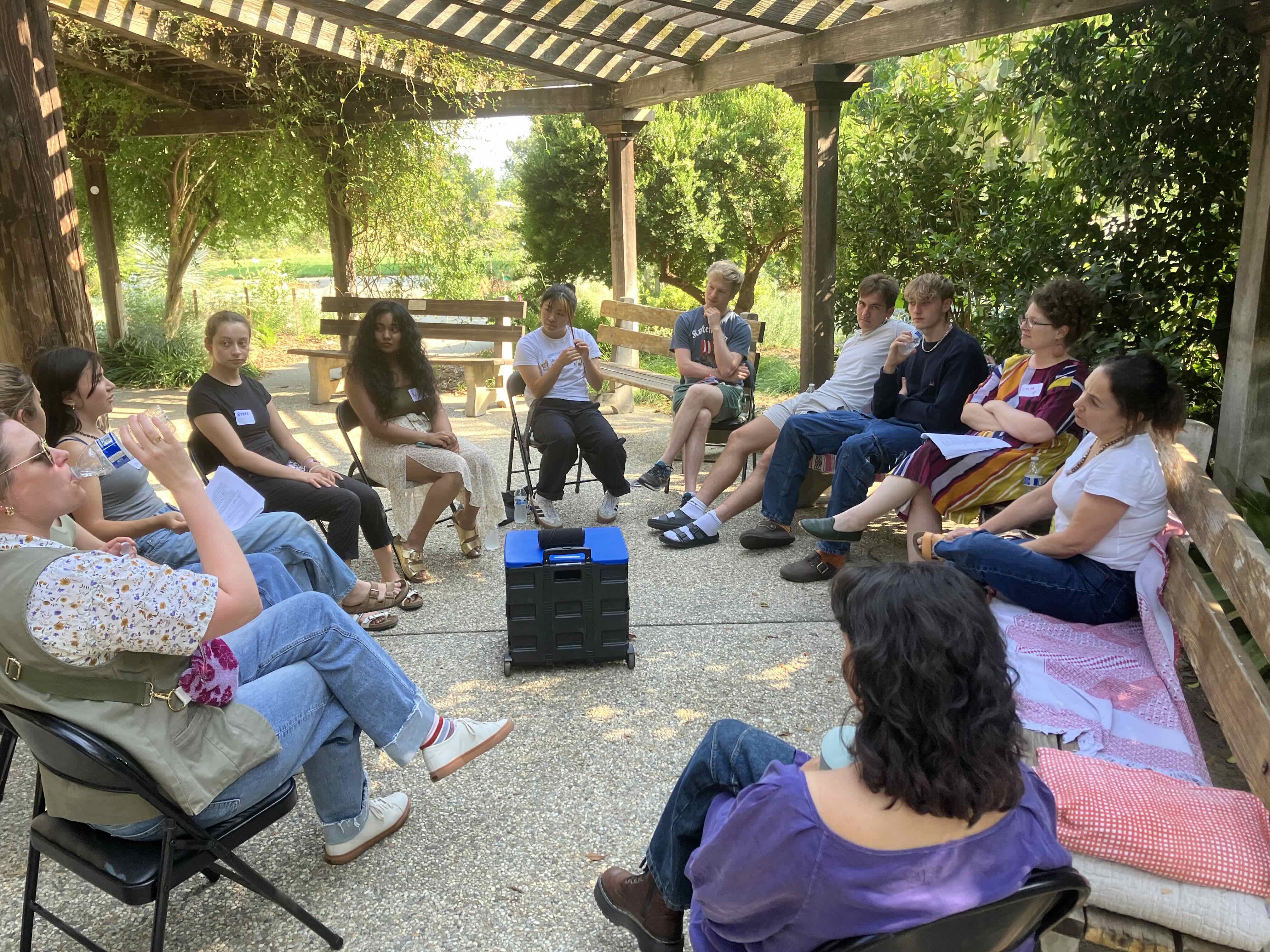
On June 4th 2025, Imagining America (IA) held a happening encouraging gratitude for all that the Earth provides for us, and deep thinking on our relationships with and responsibilities to the land. We gathered in a circle under the shade of the gazebo in the Carolee Shields White Flower Garden in the UC Davis Arboretum and Public Gardens, creating a space of learning, connection, and creation. The gazebo sits near Putah Creek, and is surrounded by greenery. Vines coiling around the gazebo reached for us and trees provided needed shade from the Davis heat. Students slowly rolled into the happening as it began, arriving by themselves or in small groups. Bushes, ferns, and flowers surrounded the gazebo, so that each time someone new arrived, it was as if they emerged from the flora. As we enjoyed the warm afternoon and the garden around us, we engaged with Indigenous knowledge which recognizes land and nature as our kin and has built reciprocal, sustainable relationships with land for generations.
As an intern with IA and the Department of American Studies this spring, I had total freedom in planning the happening – a program IA runs to bring people together in creative and connective ways. While the theme came to me quickly, it was difficult to think about how I wanted to engage people with it. It felt like I was approaching a blank canvas. But really I wasn’t. The knowledge I want to engage people with is generational and ancestral. It is nothing new, but it is something suppressed. I have been lucky to encounter Indigenous knowledge in my education through UC Davis classes like ‘Decolonizing Spirit’ with Professor Susy Zepeda and ‘Queer and Feminist Ecologies of Color’ with Professor José Manuel Santillana Blanco, as well as in research for my senior thesis. This knowledge has profoundly changed the way I understand land and my relationship with it. But many are not so lucky to encounter this knowledge or be able to take these classes. I wanted to create a space for people to engage directly with Indigenous teachings and reflect on how they impact their understanding of land and appreciation for it. With the help of the IA team, we came up with a program that invited guests to hear Indigenous voices and teachings directly.
We began by listening to audio clips from the IA Hubbub podcast featuring Patwin/Wintun cultural practitioner Diana Almandariz. Opening with a listening allowed people to sit back and take in the teachings which introduced the concepts we were going to explore. The clips discussed the Tending and Gathering Garden (TGG) in Woodland, where the local Native American community is working with the Cache Creek Conservancy to revive the area’s native habitat, and the cultural burns that they practice. When they do burns, nature responds. Deer bathe in the warm ashes, insects emerge, and birds swoop in to feed. It is a beautiful example of how humans can fit into ecological systems, supporting them and being supported by them. The podcast also grounded us in our local environment as Patwin/Wintun peoples are the original peoples and stewards of the land we were gathered on. Then we collectively read out loud the speech, “Clear Thinking: a Positive Solitary View of Nature” by John Mohawk from the book Original Instructions: Indigenous Teachings for a Sustainable Future. Each person read a paragraph of the reading until it was completed. This was a little more participatory and allowed us to hear each other’s voices, creating connection across each other and the texts. After listening to the teachings from multiple Indigenous voices, we spent time individually reflecting by jotting responses to the following reflection questions:
• Considering what you heard in the audio clips and shared reading, what has changed in your understanding of land and your relationship to it?
• What ideas stood out to you that might inspire a greater sense of responsibility to the Earth?
• What is an action or activity that you could do to practice gratitude to the Earth?
These questions guided guests in thinking through what they just received and how it may impact their daily lives or inspire an action.
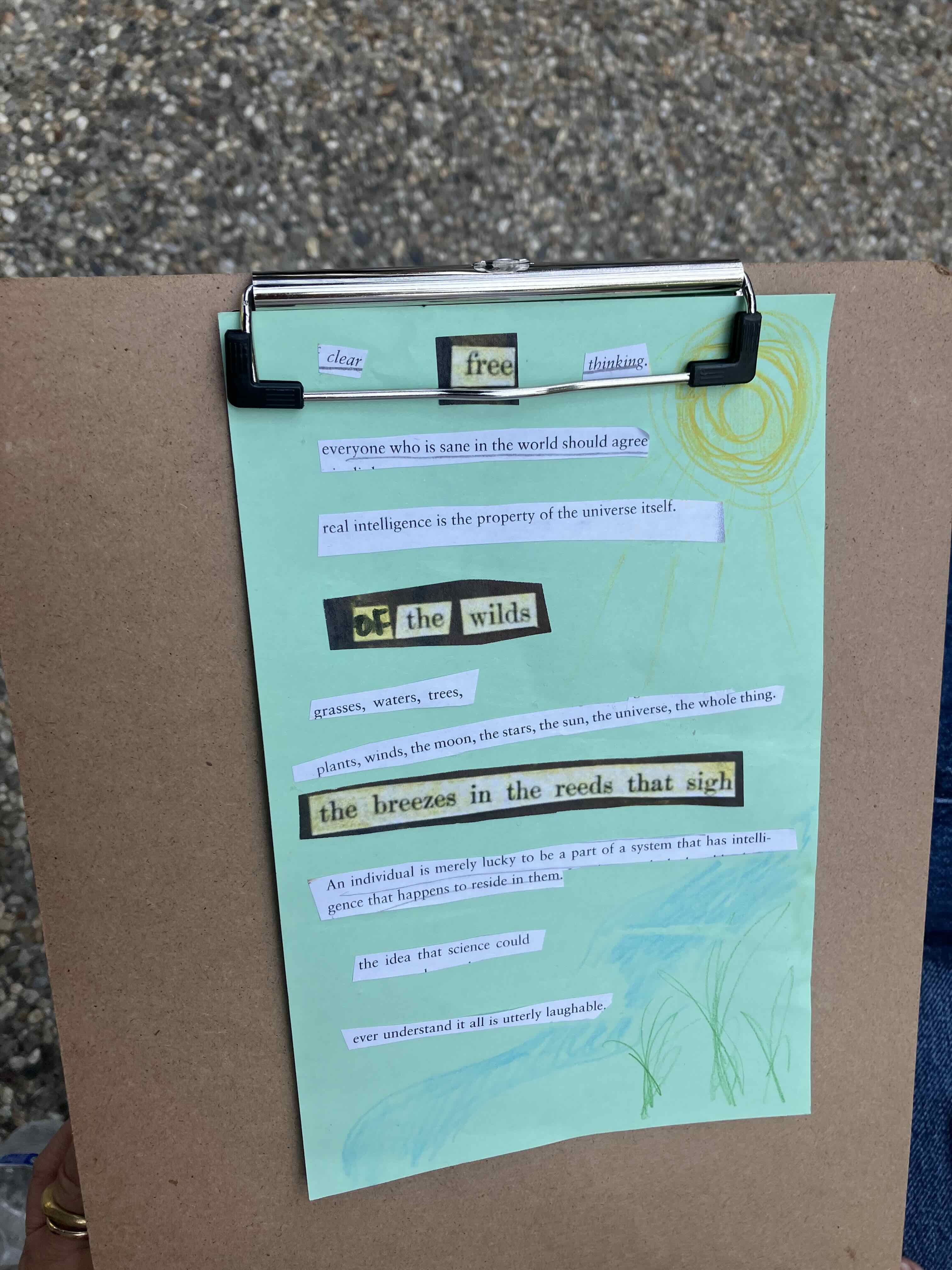
The last part of the event included creative artmaking with cut-up poetry. Cut-up poetry is cutting out words or phrases from a text and re-piecing them together to create a poem. After receiving so much information, creating cut-up poetry invites us to process and reflect on what we learned in a hands-on and creative way. People seemed to really enjoy the process of searching for and creating the poems, and many volunteered to share theirs at the end. Our poems reflected connection to the Earth, acknowledged how little of nature we could really understand, and honored the knowledge and sacredness of the universe. It was touching to hear through the poetry how the teachings impacted people, and many of us chose similar language from the readings.
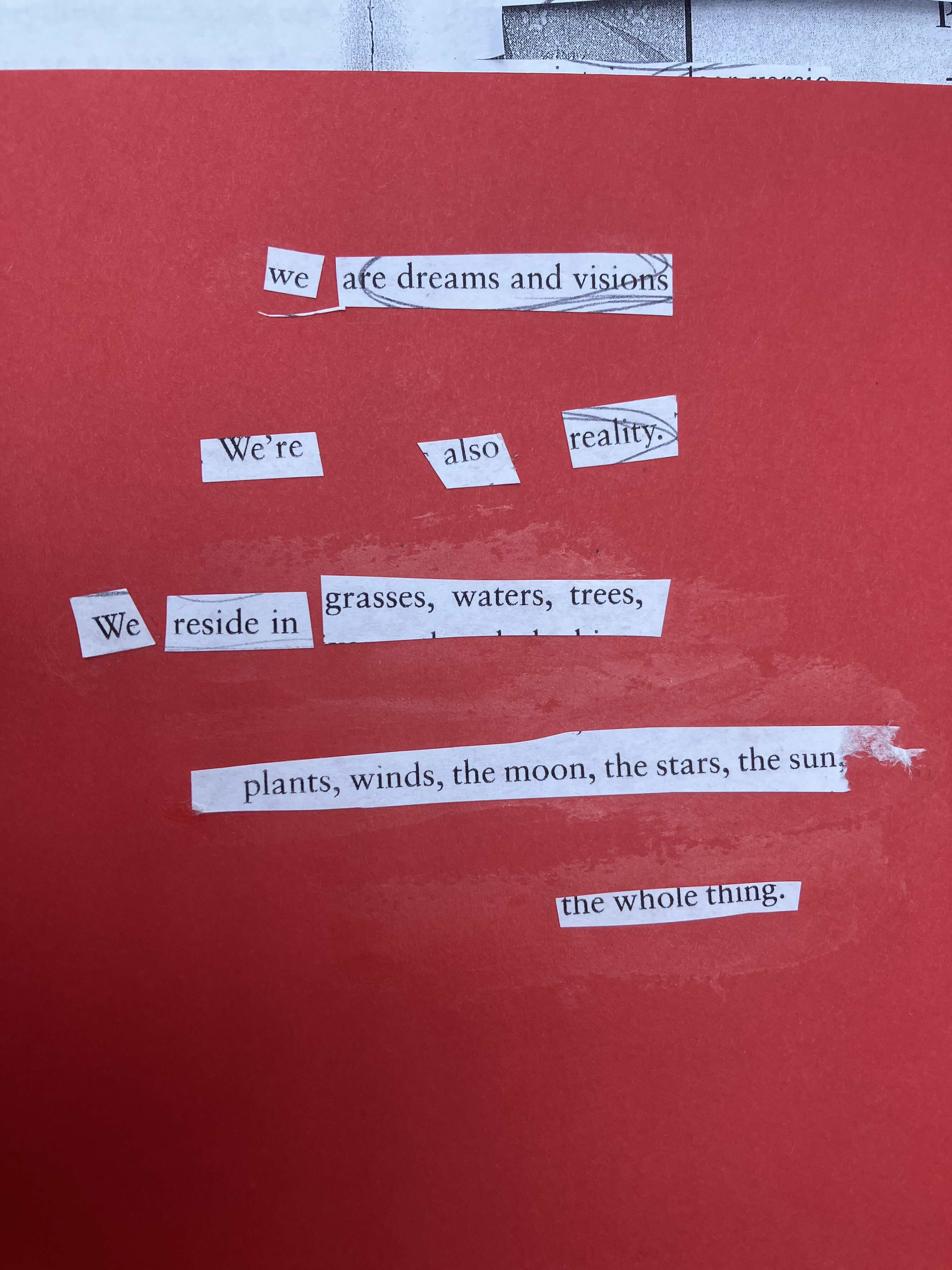
This happening was just one entry point into the journey of decolonization. In mainstream U.S. culture, we are often forced to engage with the land in ways dominant systems design, which looks like extraction, exploitation, and negligence. While it feels like we are passively living on the land, in actuality we are actively following the status quo of colonial living. The journey to undoing these systems is a long one, but starts with our thinking. This happening was just an introduction to some Indigenous knowledge that can guide us in the process of deconstructing harmful ways of thinking and practices, and relearning how to live with the Earth in a reciprocal, harmonious relationship.
Below is a toolkit for the happening for those interested in creating a similar learning space and experience.
Funding has been provided by California Humanities and the National Endowment for the Humanities (NEH) as part of the American Rescue Plan Act of 2021.