Democratizing Archives, Sensing Imagination.
Chelsea Bouldin
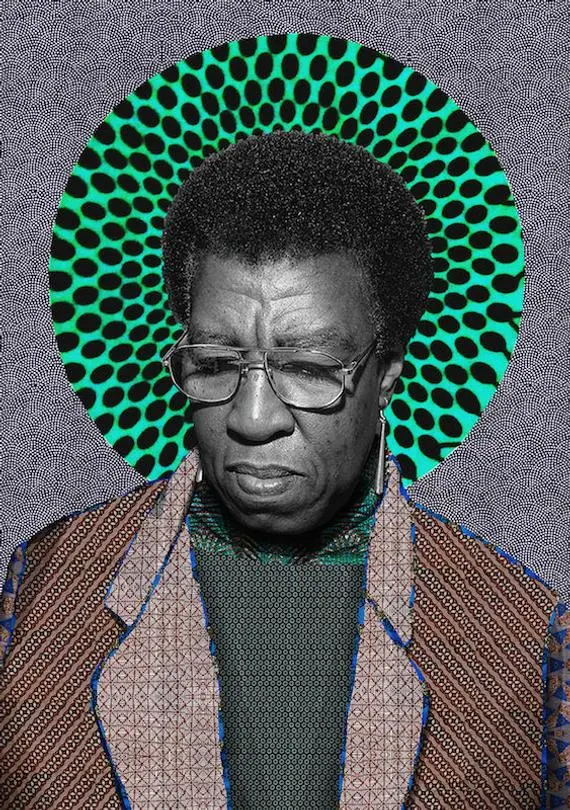
a self-taught artist from Harlem, NY best known for her
digital collage portraits of contemporary and historical Black icons)
Exercising the internal, concealed capacity to actively define my
Black-woman-self, and exploring the explicit metacognitive practices required of such work, I consider the liberatory, intellectual potential of such space. I also envision the interiority of other Black-woman-selves. I hear and answer the call to remember the encapsulated lives of those who have come before me, for those who will come after.
Although imagination has significantly become a part of trending discourse amongst those of us doing equity-oriented, justice-aimed, decolonial work, I ask, when do we seriously operationalize imagination when we are institutionally rewarded by tangible production? My public scholarship is an action-oriented response to the question, “how can we collectively practice imagination as a verb and social justice ethic by centering existent, (often)marginalized knowledge(s)?”
To engage this question, I centralize archives and literature as sites of
operationalized and unfolding imaginations. I also assert that these sites must be understood and studied as extensions of thought-work. Although thought work and expression are often conflated, I believe the cognitive capacities to assert, create, and contend the self brew in an internally unique way. Such processes have long been a part of our vast repertoires of existence and joy.
Elitist, exclusionary institutions often house the archives of public figures whose insights offer potential frameworks for understanding our histories, presents, and futures more fully. This is particularly true for marginalized communities who generally have less access to these institutions, and whose histories have been disproportionately subject to erasure from mainstream educative spaces. My work aims to democratize archives and expands Black women’s literary depictions of self using speculative fiction– a literary genre that embodies creating oneself beyond our material realities. Turning to Octavia Butler particularly, my scholarship inserts archival histories into public arenas, unearthing untapped reservoirs of knowledge. I ultimately aim to practice public archiving used for Black women to continue creating ourselves while honoring the work that has come before us.
I, like Lauren Olamina, (the Black girl protagonist in Octavia Butler’s prophetic 1993 Parable of the Sower), use my work to remind us that imagination is not a metaphor. “If we don’t save ourselves, we’re dead. Now use your imagination.” (p. 59)
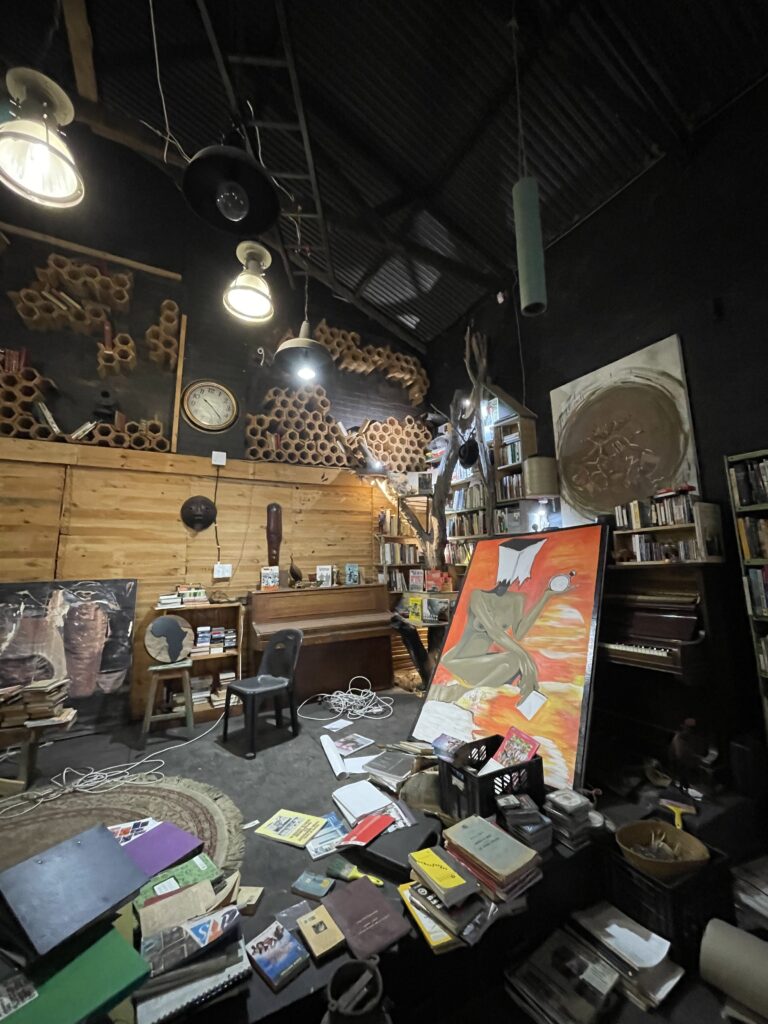
a creative hub for Black artists/thinkers in Makhanda, South Africa. The image shows books and art)
9 responses to “Democratizing Archives, Sensing Imagination.”
Leave a Reply
Funding has been provided by California Humanities and the National Endowment for the Humanities (NEH) as part of the American Rescue Plan Act of 2021.

Chelsea, thank you for introducing me to speculative fiction. This idea of democratizing archives and expanding black women’s literary depictions of self to honor those who’ve come before us and enlighten a path for those who will come after us is really intriguing. So often our stories (the collective “our” of marginalized peoples) go unnoticed or somehow forgotten. Giving voice to these stories and stories to come is such a fiercely radical and powerful thing. I salute you and the work that you’re doing! I look forward to sharing space with you and learning more about your work as I can see many points of connection in our work.
I deeply appreciate the ideas presented: that speculative fiction can be a vehicle to amplify racialized voices, cultivate identity, foster agency, and challenge the status quo. These ideas of “practicing imagination as a verb and a social justice ethic” are moving and intriguing as it can generate an active force to drive change. This framework for expression courageously challenges knowledge productions and the erasure of those voices of marginalized community members; however, it also generates a dialogue that unfolds the power and magic of stories that have been told. I am excited to learn more about how operationalization of these ideas and actionable steps towards both democratizing archives may be realized and imagining life and liberations through this work.
I don’t think the title of your article matches the content lol. Just kidding, mainly because I had some doubts after reading the article.
Can you be more specific about the content of your article? After reading it, I still have some doubts. Hope you can help me.
Thank you for your sharing. I am worried that I lack creative ideas. It is your article that makes me full of hope. Thank you. But, I have a question, can you help me?
Your article helped me a lot, is there any more related content? Thanks! https://www.binance.bh/register?ref=QCGZMHR6
Your article helped me a lot, is there any more related content? Thanks! https://www.binance.com/register?ref=L4EUT9FG
Thanks for sharing. I read many of your blog posts, cool, your blog is very good.
Can you be more specific about the content of your article? After reading it, I still have some doubts. Hope you can help me. https://accounts.binance.bh/pt-BR/register/person?ref=GJY4VW8W