Pedagogies of Possibility: Supporting Undergrads to Imagine and Build Futures of Their Own Making
Jessica Bacal & Deborah Keisch
As educators, we have been asked how can we teach about possibility in the midst of such violence in the world? We keep coming back to the question — how can we not?
If you are reading this post, you are likely familiar with adrienne maree brown, who writes and speaks compellingly about healing, transformational change and world-building.
adrienne maree brown
from the book, Emergent Strategy (2017)We are inspired by brown and others1 to ask: What does it look like, in practice, to pay attention to possibility? What does it look like inside our classrooms, in 1:1 meetings with students, in our assignments, with our colleagues? What does it look like for those of us trying to stay under the radar because we are pre-tenure or are otherwise precarious due to our job title or social identities?
Our book emerged from these questions. Pedagogies of Possibility: Supporting Undergraduates to Imagine and Build Futures of Their Own Making (forthcoming from West Virginia University Press) is a collection of interdisciplinary essays from practitioners who are supporting students to navigate challenging times with a sense of hope, and to envision (and learn how to build) more equitable presents and futures. Contributors span disciplines, and work at a variety of institutions; they offer eleven different stories about teaching through a lens of possibility. And yet we didn’t want to stop with the book — we wanted to create something that could spread and grow.
We are drawn to the metaphor of the dandelion and its seeds (Emergent Strategy 2017). Like dandelions, pedagogies of possibility might not be seen as important or of use.
adrienne Maree brown
from the book, Emergent Strategy (2017)This is what we aspire to — seeding practices that create roots across space and time. We hope these can further seed aligned ideas and projects that are resilient and connected.
Talking about the project generated both solidarity with other educators and discussion that pushed us to think deeply. Some colleagues reacted to hearing about our book as if we were living under a rock. Over a Zoom call, a Columbia professor asked, “Who is going to be the audience for this? How are you going to position it within the context of retrenchment in universities — universities where professors are being fired for what they say?” At a conference during a time when ICE activity was becoming more violent by the day, a professor at our presentation said, “People are being shot — and we’re talking about workshops?”
These are the kinds of conversations we welcomed. And we were talking about workshops — and classes, and activities, and other ways in which we gather and think with young people who are entering adulthood, inheriting this world. Many of us have grown up in schools that felt oppressive; some of us work in universities that are increasingly restrictive. Still, as Ruha Benjamin writes in Imagination: A Manifesto, there are educators using their classrooms as “laboratories for social change, incubators for seeding a solidaristic imagination” (p. 40).
We were still drafting the book and wondering about its broader appeal when we were invited to develop a Collaboratory project, and it fueled our excitement about the work. It allowed us to seed the creativity and good ideas of colleagues who believe in coming together to imagine a different future, even one that feels impossible. The workshops we developed allowed us to be in conversation with our fellow contributors, but also with our students, colleagues, and the larger IA community, as participants came from each of these groups.
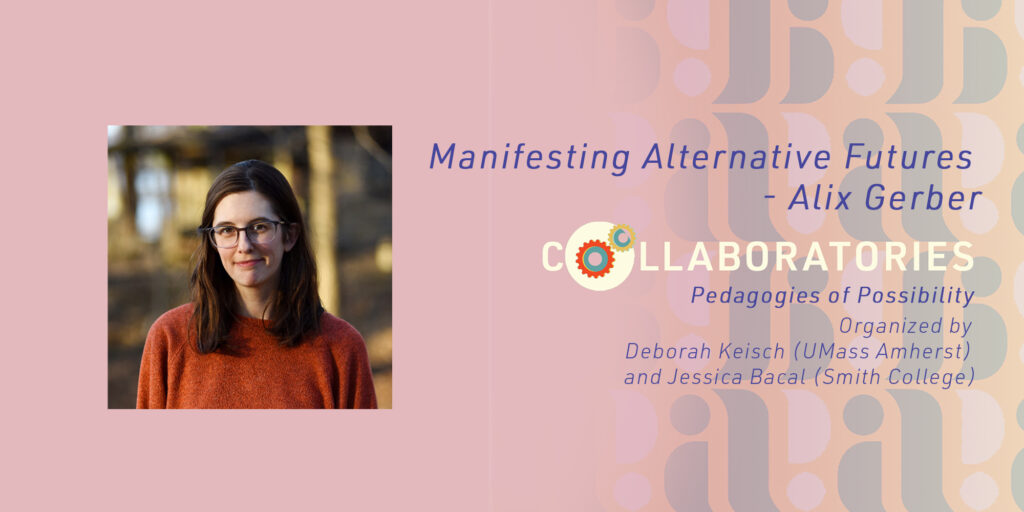
Our first workshop, led by Alix Gerber, asked this question directly. “Can you name a social transformation that you want that feels impossible?” About fifteen people showed up on Zoom, after dinner on the East Coast. Alix gave people about three minutes to answer this question — but it was more than enough time.
Free healthcare
Black folks being free to take up space
Open borders
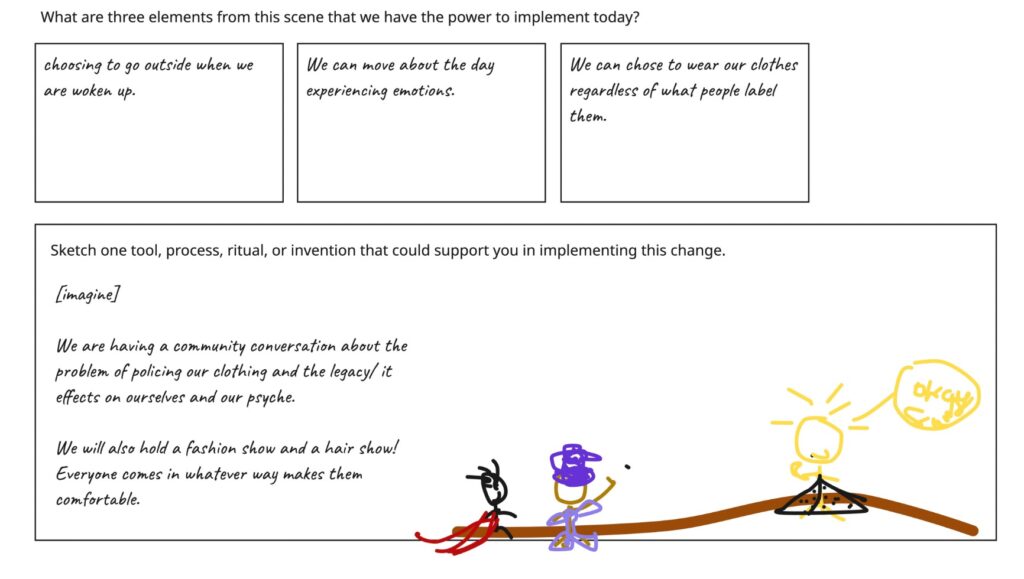
Alix then asked the group: What present day system or ‘way of being’ makes this impossible? And how are you part of that system? Next, we were invited into an imaginary future, asked to picture a moment in this future, and to draw it. “How would things look different if we imagine this transformation has already taken place?” It was fun to use Miro, the online platform, drawing stick figures with our Zoom partners.
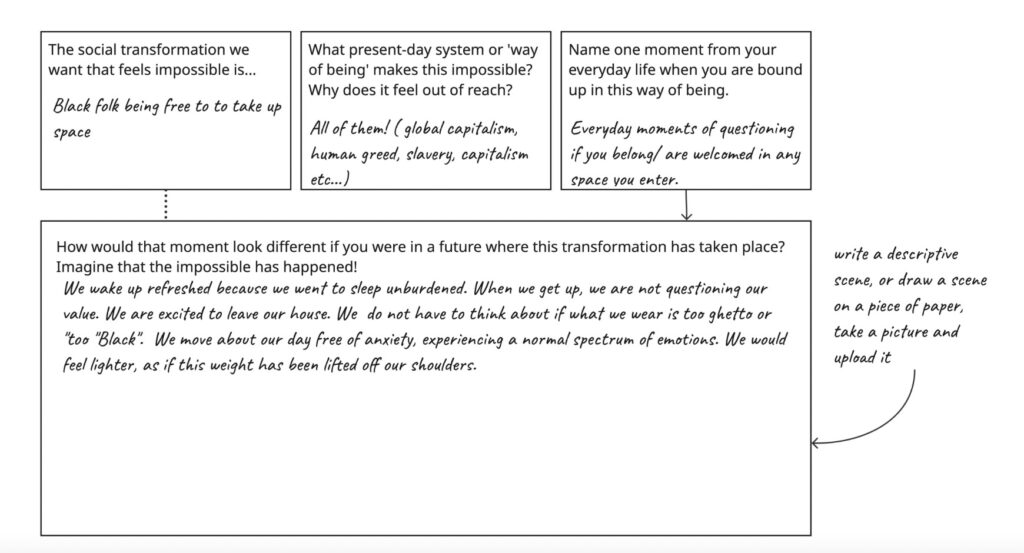
Finally, we were called back into the present. Alix asked whether there was something from our imaginary future — a tool, process, ritual, or invention — that we had the power to implement today. We’d only had an hour together, but participants seemed lit-up by the creative ideas they’d discussed.
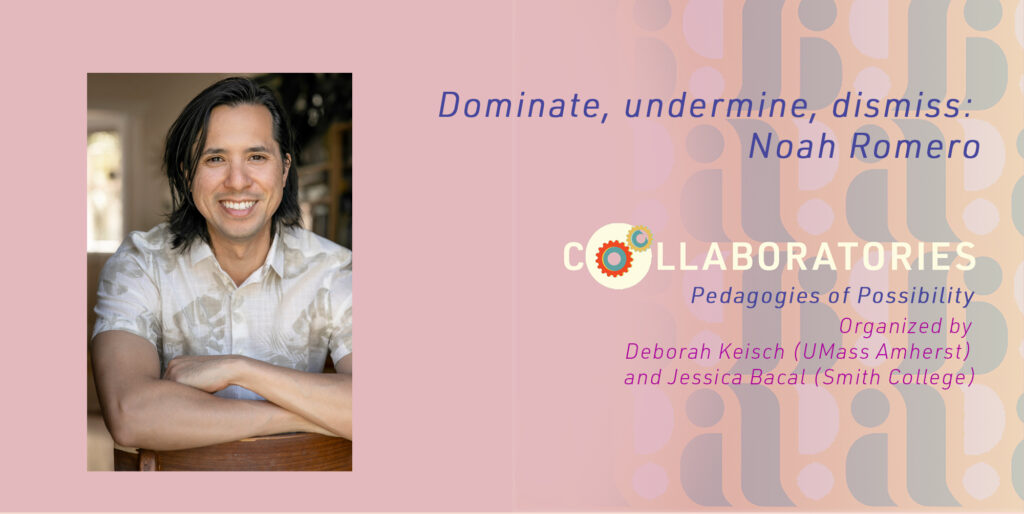
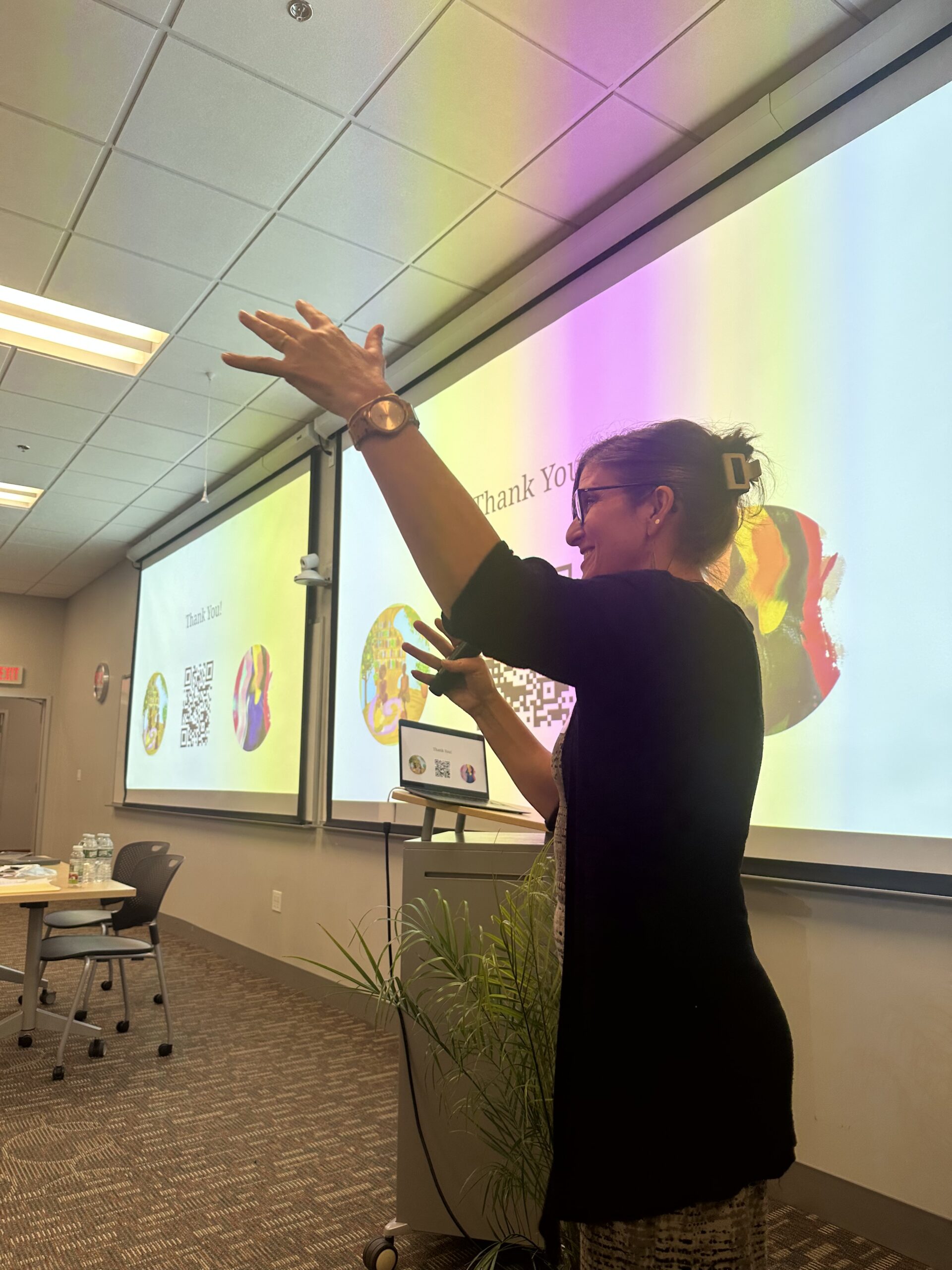
In our second Collaboratory Zoom workshop, Professor Noah Romero gave a talk about the post-colonial structures in schools that have served to “dominate, undermine, and dismiss” students’ experiences in the classroom.
He then led participants through a conversation about the ways in which this paradigm shows up in their own lives, and introduced “indigenous pedagogy,” as an approach that decenters the one-person expert. Indigenous pedagogy, Romero said, is infused with the understanding that everyone has something to teach. Something that stayed with us was a story Romero shared from Diné activist and author Klee Benally, who believed that teaching means a community is trusting you with the most sacred thing the community has — their children. Good teachers, Romero told the workshop group, are able to carry out their responsibility to their community, prioritizing healing, balance, connectedness, and reciprocity in their work. In his chapter in the book, Romero describes specific ways to build these elements of Indigenous pedagogy into the classroom experience.
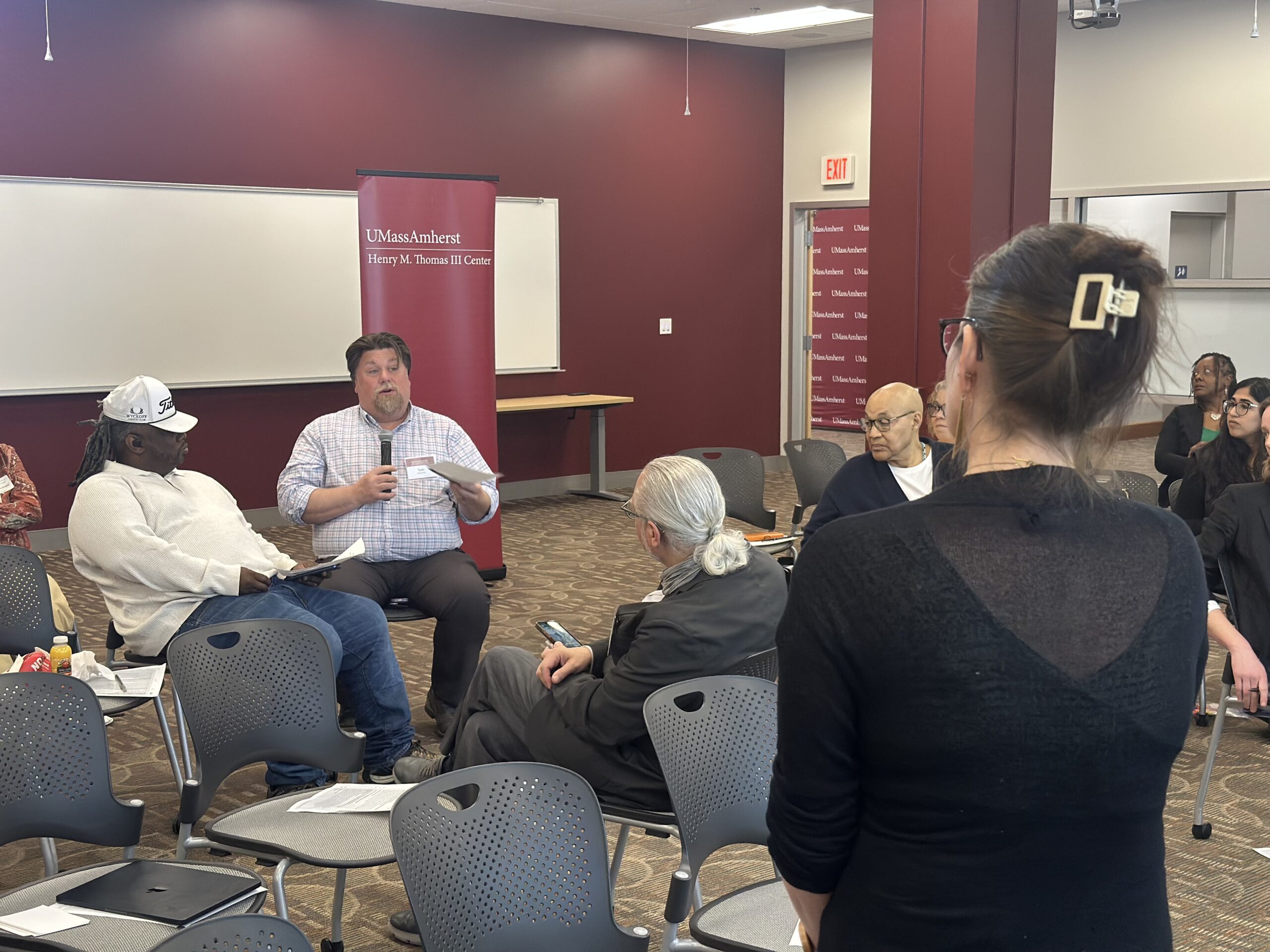
In a community-engaged teaching and research symposium in May 2026, we adapted Alix Gerber’s activity with a room of educators, community advocates and activists. The positive energy in the room was palpable and the resulting conversations about how we do this kind of visioning work were complex and provocative. One of us worked, over the past year, to support campus community members from immigrant-origin families — it was a long project of coming together with grassroots organizers, finally getting institutional support. Dandelion seeds are small, and can face strong headwinds.
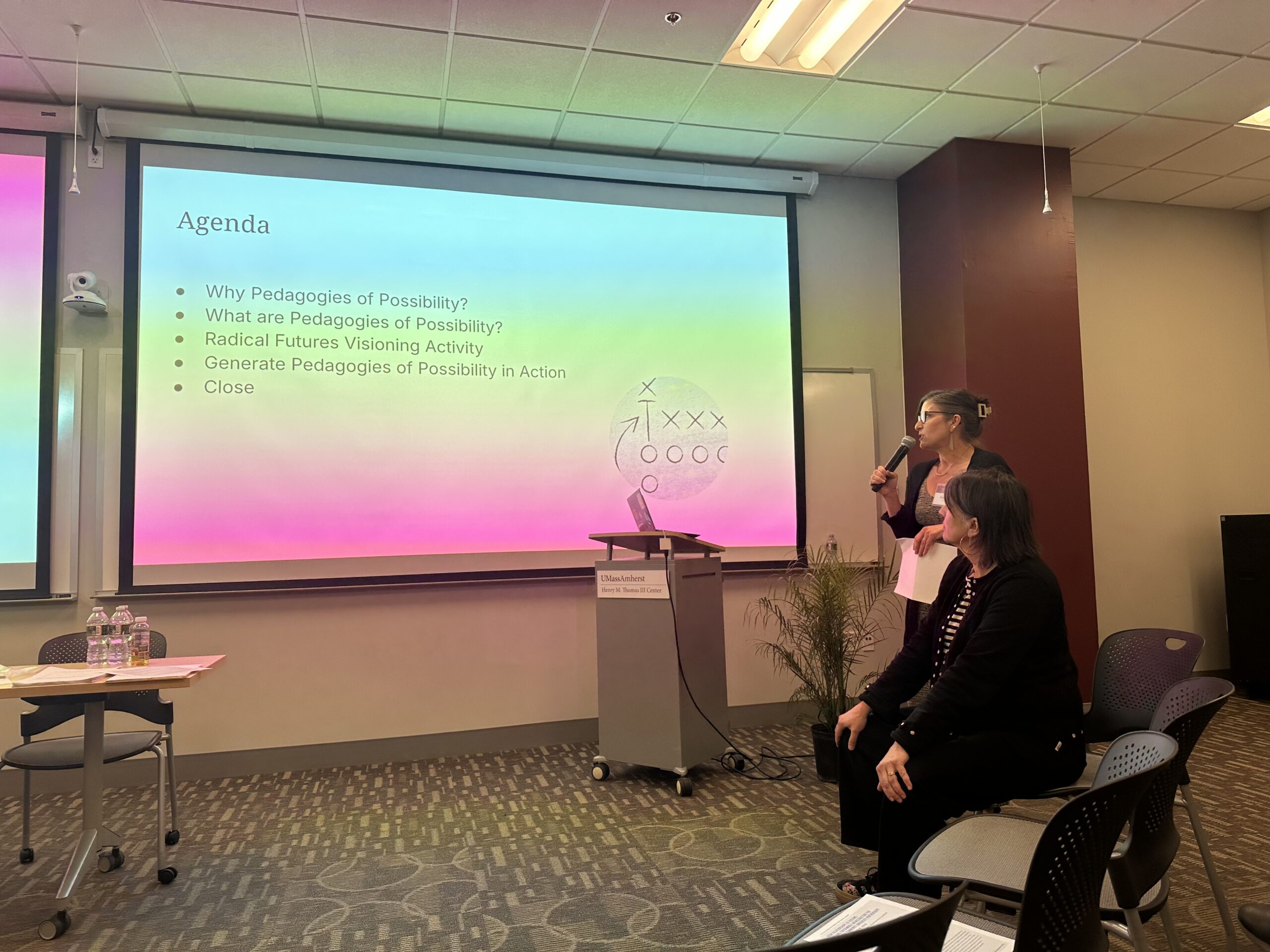
Other seeds are being spread. We presented about pedagogies of possibility at two conferences, talking and building with other educators, and we have additional writing in the works.
We are aware that there are many practitioners engaged in pedagogies of possibility — both in and outside of formal classrooms. We seek to share, inspire, and create. To learn from each other. To build with one another. To normalize possibility. We invite you to contribute to a collection of online resources — your contribution could take almost any form: syllabi, lesson plans, activities, reflections on experiments or tried and true practices. In the spirit of collective growth, we want to disrupt the norms of academia where people tend to be siloed, and where sharing is discouraged. We need collaboration and connection to build more equitable and humane worlds. Please reach out to us if you have something to share! You can reach us at our individual emails or via the contact form on our website. We look forward to building with you!
- 1 Benjamin, R. (2024). Imagination: A manifesto. WW Norton & Company; brown, a. m. (2017). Emergent strategy: Shaping change, changing worlds. AK Press; Hayes, Kelly, and Mariame Kaba. Let this radicalize you: Organizing and the revolution of reciprocal care. Haymarket Books, 2023; Kelley, R. D. (2022). Freedom dreams: The black radical imagination. Beacon Press. ↩︎
Funding has been provided by California Humanities and the National Endowment for the Humanities (NEH) as part of the American Rescue Plan Act of 2021.