Assembling Zines in the Fault Lines
Shromona Mandal
Zines are self- or community-published materials that can range from primarily visual art such as drawing, photography, comics, or posters that are folded or bound into booklets among other forms, for the purpose of physical, digital, or do-it-yourself circulation. Zine-making has a central place in feminist knowledge production as an iconic and oppositional form. But more than its allure as a culturally feminist object, zines are a particularly storied site for women of color feminisms. Mimi Thi Nguyen’s historiography of Riot Grrrl, understood as the origin of feminist zines, disrupts the empowering frame of “riot” that removes the racial conflict and violence that produced that metaphor. Mimi Thi Nguyen excavates the fact of the “construction” of opposition by locating the race-riot that produced the title when in 1991, in Mount Pleasant, Washington D.C., when an African American policewoman, at behest of white residents, shot a Salvadoran man and it resulted in a two-day conflict between the Latine youth and the Metropolitan Police Department. The context through which the feminist zine gained its oppositional and intimate voice is no accident and neither is the absenting of race from the feminist historiography of its iconic subculture.
Ramdasha Bickceem, considered a founder within the Riot Grrrl scene, wrote and circulated GUNK as a teenager to undermine the erasure of Black girlhood from the cultivation of the oppositional subculture of grrrl zines so the disavowal of race was always a hegemonic project for the commodification of zines. The POCZine project, a 2010s online repository of zines from people of color, argues against the grain of the pulp and science fiction “fanzines” are the seminal moment of zines, and places the birth of the format in the Harlem Renaissance with the germinal “FIRE!!! Devoted to Young Negro Artists (1926)” with featuring writers such as Langston Hughes and Zora Neale Hurston. Whichever you look at it, the politicized zine culture has always cultivated a Black cultural consciousness from within the faultlines of white capitalist patriarchy. I’ve embarked on a brief history of the politicized feminist zine because I want to share a bit about why I have spent time assembling zines as a counterpart to my academic labor. Even though, as Mimi Thi Nguyen warns, zines like any form of subcultural and oppositional cultural and knowledge production are always available for commodification, and the academic marketplace is no bystander in this dynamic.
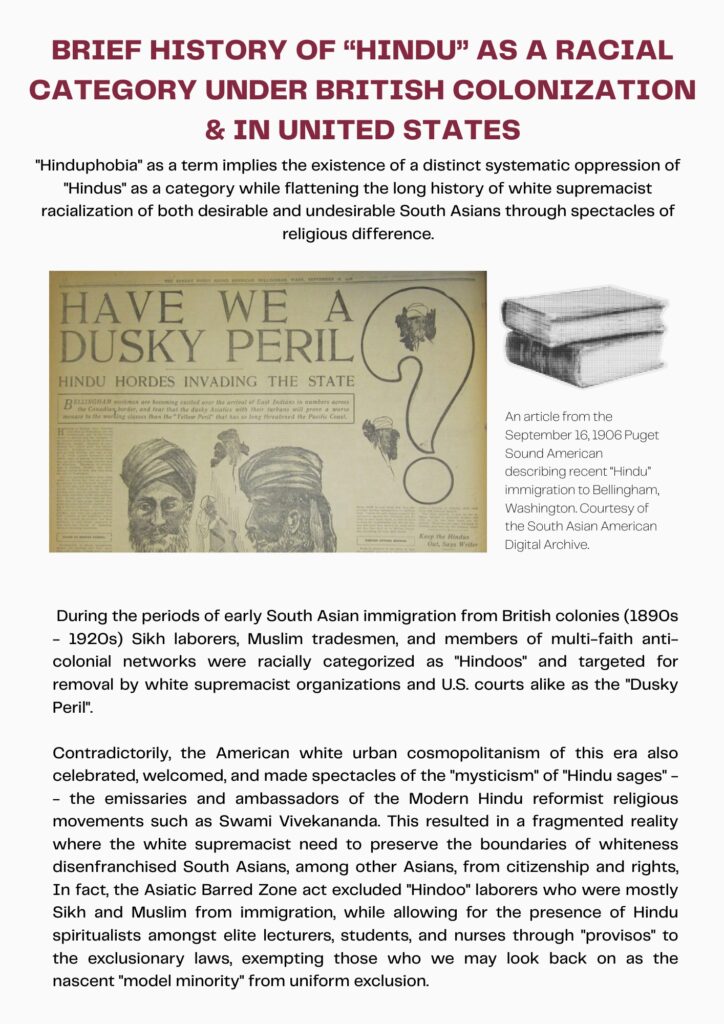
My dissertation research asks how Hindu Nationalism foments in the wealthy racially segregated suburbs and ethnoburbs of Metro Atlanta and my ethnographic method of “studying up” requires me to straddle the simultaneity of power and marginalization that my interlocutors navigate. I enter the worlds of my interlocutors through a narrow adjacency since I am a student in a professional degree with the right national origin, religious background, caste capital, and class status. However, my ability to remain an “insider” remains precariously balanced against my public life as a non-binary lesbian scholar and my willingness to listen, hear, and responsibly interpret the lives and relations I become privy to. However, almost as soon as I began to design and build relationships for my ethnography, I came face to face with a political exigency — the introduction of a legislative bill criminalizing “Hinduphobia” in Georgia. Up for consideration in the January-May 2026 legislative session, I’ve had to concede my desire to organize against this measure to both, the legislative strategy to demobilize the bill, and the relational conundrum of my ethnography. I believe this is one of the many moments where I will stand at the crossroads of balancing the costs of inaction for my (and many other) communities, the narrowness of a liability-oriented professional standards, and potentially jeopardizing relationships with future and present interlocutors before I even begin to “study up”. While I abstractly grappled with these professional and personal dilemmas, a friend came up with the idea of making a political education zine on “Does “Hinduphobia” even exist?”
We began by brainstorming what would be effective in communicating a critical angle to the seemingly multicultural claim that protections against “Hinduphobia” are necessary anti-racist measures organized by a Hindu Nationalist organization. I began to realize that making a zine afforded me the anonymity I needed to intervene in the Hindutva tide, afforded me the room and the privilege to figure out how to use my knowledge of South Asian American Studies towards political education product, and gave me an opportunity to participate in circulating my ideas outside of academic sanction and publishing timelines. Hatching a plan to distribute the zine along local networks gave me the chance for community outreach beyond the objectives of my ethnography. In fact, the co-creator of my zine and the audience it reaches would be a cushion against the risks of “studying up”. I began to remember that I am not just an ethnographer but also a zine maker, participating in a long culture of harvesting the faultlines of formalized (and often apolitical) cultural industries in alliance with supremacist hegemonies. Assembling DIY zines requires assembling alternative, oppositional communities through a cultural consciousness. It is the space of praxis where collective and individual voices can develop according to community and subcultural logics rather than the marketplace’s demands. Previously, I thought of zines as places where the use-value of my education can be realized and community histories can be activated. But assembling this zine in the faultlines of an active and exigent political moment and against the grain of my own academic methodology, has expanded my sense of what zines have to offer graduate students and public scholars.
The zine I am co-writing is still pending my peer-review from the coalition we are working within to demobilize the “Hinduphobia” bill. But here is a sneak-peek:
Funding has been provided by California Humanities and the National Endowment for the Humanities (NEH) as part of the American Rescue Plan Act of 2021.