Joshua Finnell
In the history of printed knowledge, the miniature book has always elicited a mixture of curiosity, ridicule, and delight. Among the earliest of its kind, the Diurnal Mogantium emerged in 1468, no larger than a cupped hand, set and bound by Peter Schöffer, a disciple of Gutenberg. That something so small could carry the weight of devotion (prayer books, hymnals) suggests that depth has never been a matter of dimension.
In the 16th and 17th centuries, these tiny tomes found their place close to the body, tucked into coat pockets, traveling as silent companions through the corridors of daily life. To carry a book is to carry a world. To carry it near the heart is to acknowledge that some worlds are worth keeping close.
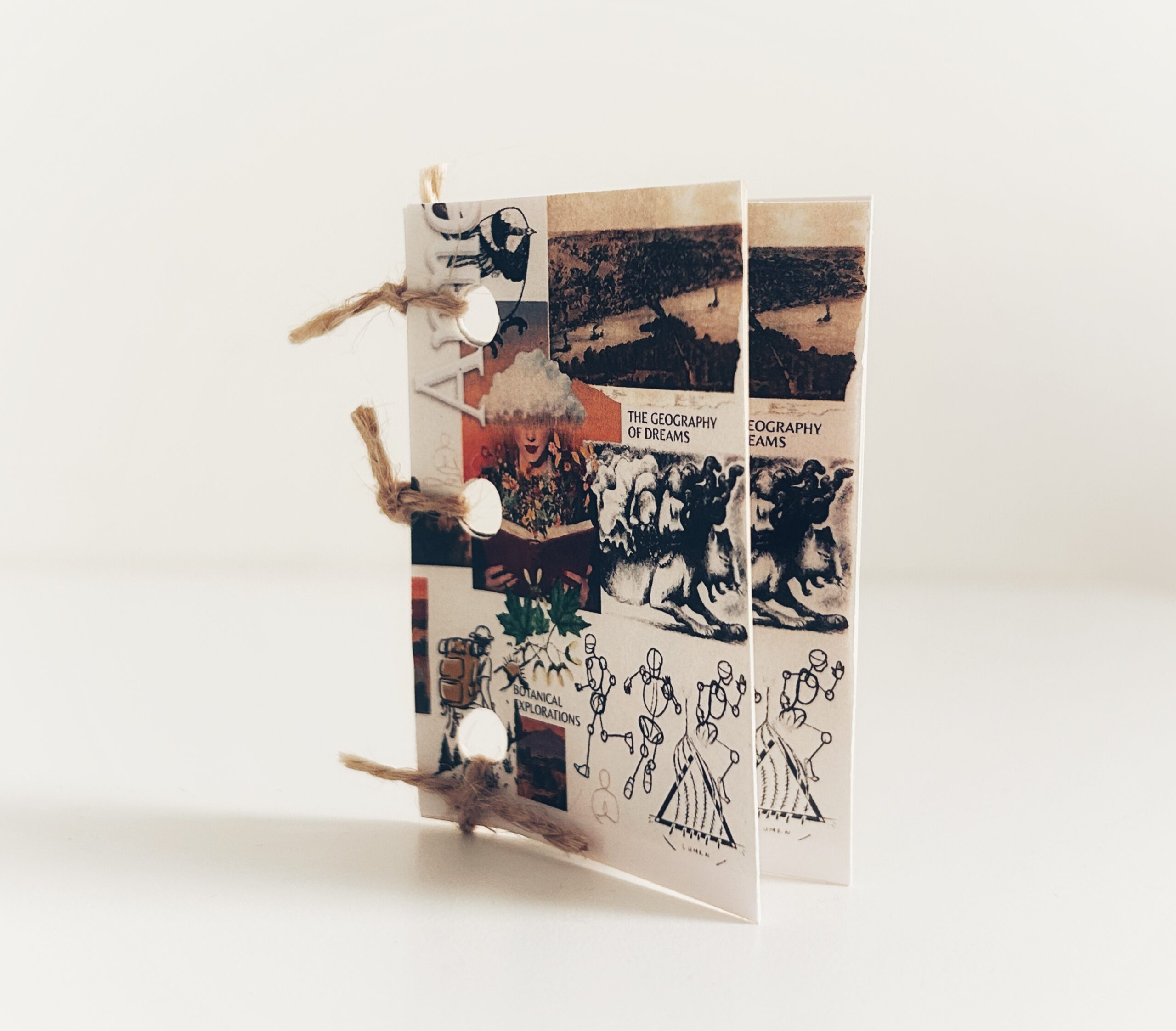
This four-page miniature is made in that same spirit. It is a collage, but it’s also a cartography of loved ones and ways of being present in this world. It’s all that carries me and all that I, in turn, hold. For what is a life, if not a small and sacred volume, passed between hands crafting each chapter?
Funding has been provided by California Humanities and the National Endowment for the Humanities (NEH) as part of the American Rescue Plan Act of 2021.