Rula Awwad-Rafferty
I loved the intentionality and boundedness of the questions posed, the Pirya Parker approach; and the simplicity and freeing of the paper plane.
I used the paper planes in several settings: with TAs to help them recognize their own paths of imagination and that of their students, in my own capstone class which added lightness, joy, and served as a community builder, and in a critical faculty meeting where they helped us realized multi-dimensionality of being there.
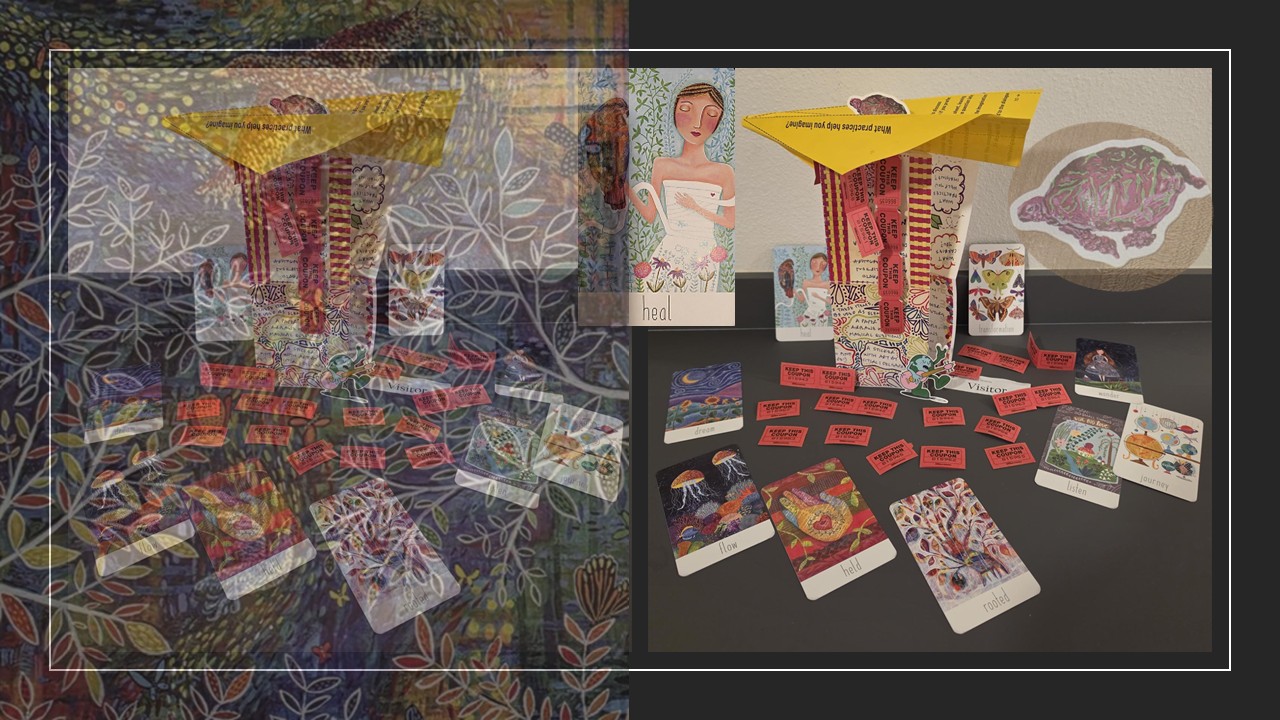
In the Moment Oracle Cards — created by my friend, artist Julene Ewart — meeting Imagining America’s deep questions folded into a simple, fragile, but assured paper plane. Who could have predicted how dangerous or how revelatory that combination might be? And yet the answer arrives with a kind of quiet certainty: a merged synchronicity. Even when contradictions appear, there is no doubt. Something softens. Something releases. A lightness of heart emerges, and with it. New portals of imagination open as if healing were simply the act of remembering how to wonder.
There is a childlike freedom in a paper plane. One question written on its wing, “What helps you imagine? — and then the launch. A return flight. Another question. Another launch. A sky filled with small, brave invitations to wonder.
The beauty is in the multitude: ideas tossed gently into the air, unjudged, unfiltered, simply allowed to exist. Possibilities drifting like seeds certainly will take their roots, in their own time.
Then the oracle cards — drawn in sets of three — each one offering a phrase, an image, a whisper. Reading them becomes a conversation with one’s own inner stories, the ones we rarely pause long enough to hear, yet their shadows hold us in certain frame. The old stories hum, and new possibilities and reconciled truths emerge. And in that moment of listening, something shifts. A realization. A release. A sense that everything is where it needs to be right now; suddenly we can see!
I find myself at peace — grateful for what has been and filled with joyous curiosity about what lies ahead. The veils feel thinner, as if the world is inviting me to look beyond the obvious, to explore the unseen, to trust the next opening.
Funding has been provided by California Humanities and the National Endowment for the Humanities (NEH) as part of the American Rescue Plan Act of 2021.