Enacting Radical Imagination in Higher Education: A 2025 Collaboratory Report
By: Kendall Bryant and Ijeoma Njaka, Red House, Georgetown University
Photos: Logan Wang, Red House, Georgetown University
Introduction
Critical Speculative Design for Anti-Racism in Higher Education, an elective in the MA in Learning, Design, and Technology at Georgetown University, uncovers the ways in which legacies of racism and exclusion, which are imbricated into the design of the university, constrain the futures of the university itself. In this course, students learn how to use practices of critical speculation and play to reimagine our educational institutions from the root. The class asks students to imagine beyond our current reality. The act of imagining a better reality is speculative work (Imarisha, 2015), and it is also rigorous, powerful, and visioning work. Imagination becomes a map.
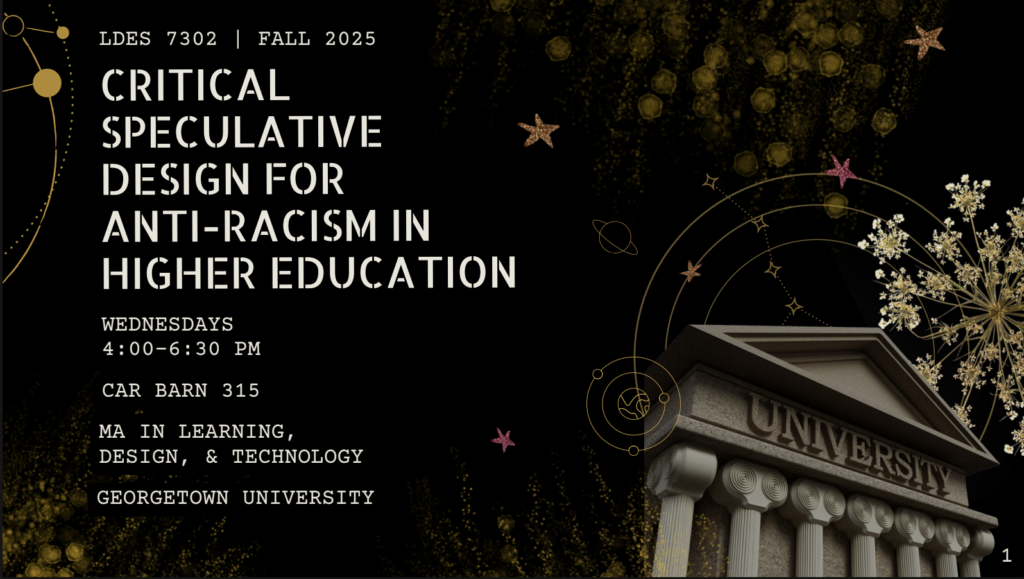
As a final project in Fall 2024, students created an artifact from or an intervention for an anti-racist future in education. Projects included zines, short stories, newspapers from the future, collages, visual artwork, and even an educational guide for a museum exhibit which does not exist (yet). This final project, distinct from a typical essay or test, asked students to deeply immerse themselves in a different version of reality and explore its consequences. The ultimate goal was for students to create an imagined artifact so tangible that it could only ripple through to reality by offering clear tethers to an alternative world.
In Fall 2024, the EnActors—performing artists and faculty developers who use applied theater practices to dramatize scenarios that underscore and reveal racialized inequities within the university community through dialogue—visited the Critical Speculative Design class to help students workshop their artifact ideas in development. This generative visit sparked an idea: what if we could use performance techniques to help make student visions immersive and embodied for a broader audience? The Imagining America Collaboratories grant allowed for us to continue working together to build out the powerful ideas that the students came up with.
Enacting Our Radical Imaginary
Enacting Our Radical Imaginary (EORI): A Place-Based Activation of Speculative Learning Design, a 2025 Collaboratory, aimed to turn student projects into embodied learning experiences for the broader Georgetown community. The primary partners for this work included students and faculty from the Critical Speculative Design course; the EnActors; and the Red House, Georgetown’s curricular innovation unit, and its Baker Family Terrace, an outdoor studio classroom and gallery. As the Collaboratory took shape, other key collaborators and contributors included students from the EnActor-taught course, Facilitating Across Differences; the MA in Learning, Design, and Technology; and, the Georgetown Dialogue Initiative.
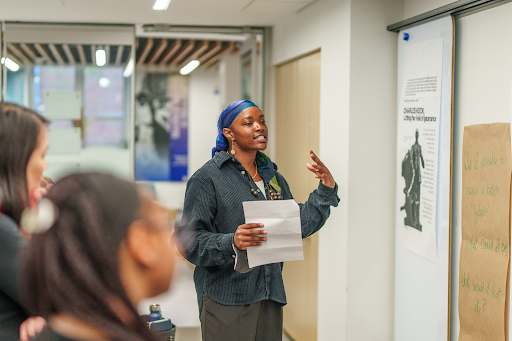
Practically, this collaboration took shape over nine planning sessions, a devising workshop, and one public presentation of the work in Spring 2025. In March, the EnActors led a 2-hour workshop inspired by devised theater work with students and faculty from the Fall 2024 section of the class. Focusing on 4 final projects, the group developed scenes that brought the speculative artifacts to life. Of the 11 students enrolled in the Fall 2024 section of the class, 7 attended the devising workshop. The workshop also included 2 undergraduate students from the Spring 2025 EnActor-led course, Facilitating Across Differences. Dinner was provided and eligible students received stipends for their participation.
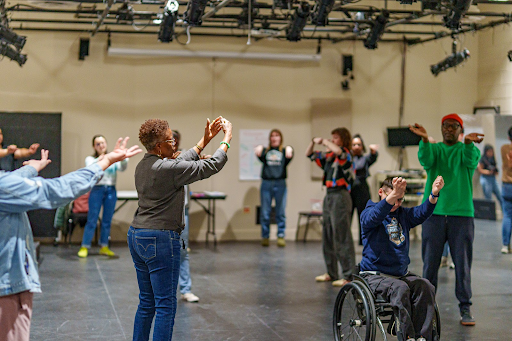
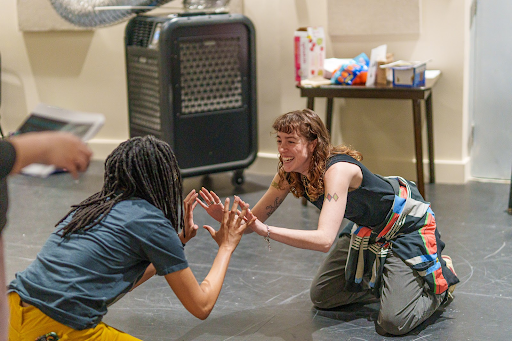
Inspired by the content generated from the devising workshop, the EnActors, key Red House staff, Facilitating Across Differences students, and graduate students led an immersive, public-facing event entitled Enacting Our Radical Imaginarium: An Incubator for Reimagining Traditions in Higher Education. This 2-hour event invited the ~20 attendees (including faculty, staff, undergraduates, and graduate students) to engage in participatory and creative play anchored in the question of “What if we didn’t just rethink higher education, but reimagined it?” alongside dinner and discussion. Due to rainy weather, the event was not held outside on the Red House’s Baker Family Terrace, but indoors in the Office of Student Equity and Inclusion’s Community Room. We rounded out the Collaboratory with a debrief conversation about what we learned from the experience in April 2025.
What We Discovered
Radical Imagination Is a Must in Collaboration
The EORI Collaboratory was the first of its kind, breaking down silos in the university in the name of collective imagination. We were dancing in the dark to set up this collaborative space and in the process, we stumbled upon constraints that we didn’t anticipate. We had to think and act radically to ensure that every collaborator, from the EnActors to the students, were compensated fairly for their ideas and time. By the end of the journey, we learned that there is rigor and labor in pushing back against the institutional silos and checks that foreshorten collaborative possibilities
Play is Rigorous
In both the devising workshop and the presentation of the work itself, returning to that boundless space of imagination that is most available to us as children posed a great challenge. We had to work in and through the vulnerability of suspending belief, struggling against notions of rationality and positivism in order to engage fully in a realm of possibility. Pushing against these epistemological barriers with embodied practices showed us that play is truly a skillset that can be used to face complex problems.
Inviting Joy is a Practice
This collaboration underscored the need for joy on our campus. In the current national and global contexts, both the devising workshop and presentation gave participants the opportunity to grapple with existential questions from vantage points of positivity and possibility. Indeed, the laughter and smiles during the devising workshop led us to consider: What would it look like to consider joy and fun as success metrics for a workshop versus attendance and skill attainment? Bringing this approach to the presentation and wider audience emphasized the power of seeking joy in community with campus stakeholders.
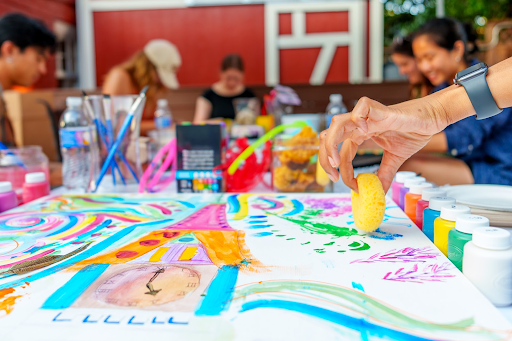
Additionally, the joy-centered approaches sparked through EORI carried on in other lines of work after the EORI Collaboratory concluded. In the 2025-2026 academic year, the EnActors led their Tools for Joy in Oppressive Times workshop series. The Red House curated a new exhibit of student artwork entitled Playing with Process: Unlearning Limitations for the Baker Family Terrace, including pieces from Critical Speculative Design students. During the launch event for the exhibit, guests played yard games, made chalk drawings, and added to a collaborative painting which reimagined Georgetown’s iconic Healy Hall clock tower landmark.
In Closing
This collaboratory helped a network of campus partners not only be inspired by student-created designs, but to create new experiential and embodied learning opportunities for the wider campus community. Moreover, this opportunity asked the practitioners to truly commit to the principles of radical imagination and play across the rigid siloing of higher education. The hope of the Critical Speculative Design class is that students design work they find important, compelling, and anchoring for their future practice as designers and thinkers. Expanding on their designs through the collaboratory also allowed the broader Georgetown community, as well as the practitioners leading the project, to be viscerally changed and expanded by the maps students provided to alternative realities.
About the Red House
Georgetown University’s Red House, founded in 2013, serves as a curricular and educational R&D unit focused on transformative education. Through its projects, the Red House designs and implements innovative classes, programs, and initiatives that respond to the challenges facing higher education while also aiming to effectively and equitably benefit our students and society.
Funding has been provided by California Humanities and the National Endowment for the Humanities (NEH) as part of the American Rescue Plan Act of 2021.