Creating Refuge: A 2025 Collaboratory report
College Civic Engagement Centers explore creativity as a practice of community care, creating refuge in these unprecedented times.
– Grace Lee Boggs
Introduction
At small residential colleges, an intimate learning community helps foster practices of civic participation and engagement. Current events often serve as ‘teachable moments’ – opportunities to educate and engage critically in real time, to cultivate informed civic action.
In November 2024, colleagues from civic engagement centers at Bates, Bowdoin, Carleton, and Macalester Colleges connected to talk about the climate for student civic engagement and participation leading up to and following the 2024 election. Students at our institutions were grappling with complex realities like Russia’s invasion of Ukraine, the overturning of Roe v. Wade, the end of affirmative action, escalating violence in Israel and Gaza, devastating climate catastrophes, diminishing faith in public institutions, profound political polarization, the movement for Black Lives, and challenges to democracy. Those of us in civic engagement centers wondered: Has higher education’s response to recent student protests shifted the culture of student civic engagement? How might our communities be impacted by anticipated changes in policy and enforcement with the new presidency? When the world’s challenges seem insurmountable, how can we scale them down to a size we can address? How might we help students move from the idea of caring to actual practices of care?
From these and similar questions, and with mini-grant support from Imagining America, a national higher education consortium, the Creating Refuge Collaboratory emerged as a collective effort to explore the ways in which civic and community engagement centers could facilitate intersectional spaces of community care, resiliency, and creative resistance for students and communities.
Our goal was two-fold: to create an emergent space for the exploration of shared interests, ideas, aligned synergies, and possible shared programming between our four campuses; and for each campus to develop a project – an experiment – using arts and creative practice to support student civic agency and strengthen community resiliency. This article highlights our individual experiences participating in the emergent space and the projects we cultivated on our respective campuses.
An Emergent Space for Connection & Reflection
The core Collaboratory participants were Danielle Trajano (Carleton), Samantha Cogswell (Bowdoin), Samuel Wegner (Macalester), Stephanie King (ALL In) and Jenna Dela Cruz Vendil (Bates). Initially, we used monthly meetings to get to know each other and learn about the local contexts that inform the culture of student civic and political engagement at our different institutions – from union organizing to campus demonstrations on Gaza and the aftermath of George Floyd. Together, we learned about the unique cultural contexts that inform our student leadership and community engagement work. Over time, the Collaboratory became a valuable space for processing the rapid changes the new U.S. administration made in its first 100 days, including increased removal and detention of immigrants, dismantling and restructuring of government institutions, and attacks on higher education.
When connections moved into trust, the Collaboratory became a space in which participants brought questions about their own work, explored resources, and shared advice where a appropriate. Sometimes, it was a space for slowing down and recognizing our full selves as parents, partners, artists, cultural organizers, or members of faith communities.
“Joining the Creating Refuge Collaboratory encouraged me to bring my full self to this work. Through the course of the Collaboratory, I was able to find refuge in connecting with colleagues in similar roles to mine. Our check-ins didn’t have big agendas, but they created space for human connection. We talked candidly about the challenges we faced navigating the political landscape both personally and in our professional roles; we discussed artists, writers, and experiences that were giving us creative inspiration; and we learned each other’s stories. Outside of our check-ins, the Collaboratory allowed me to imagine ways to incorporate something I love, visual art, into my work with students and the community.”
Danielle Trejano
Assistant Director of Student Leadership programs
at the Carleton Civic and Community Engagement office
“The Collaboratory has given me ample room within which to consider how I create space for students to see civic engagement as a diffuse and expansive set of pathways instead of as a linear, guided process. I continue to wrestle with the concept of refuge with regards to civic and social change: I see these concepts as necessarily public, messy, and contestable, and when working with students in this realm, I feel the need to incorporate community organizations and contextual examples to illuminate principles like self-interest, collective action, and more. However, my colleagues in the Collaboratory have shown me the many ways in which creating spaces for belonging on campus can provide a creative spark for students before or as they begin to find societal connections to their civic education; as a result, I’m considering how I can balance those internal and external dynamics when structuring civic and social change programs.”
Sam Wegner
Macalester College
“Being a part of the Collaboratory over the past year proved to be immensely rewarding in unexpected ways. Having a regular time to connect with colleagues from Bates, Macalester, Carleton, and the ALL IN Democracy Challenge became a connection point that I looked forward to each month. In our debriefs, I was prompted to both distill what was happening on our campus and expand my perspective on what was happening more broadly as I heard about what was happening on campus elsewhere in Maine and in Minnesota. I found myself continuing to reflect on our conversations from the calls with my colleagues here at Bowdoin (and occasionally having a guest appearance from one of them on the call!), which allowed the relationship to permeate more widely.”
Sam Cogswell
Bowdoin College’s McKeen Center for the Common Good
Jenna Dela Cruz Vendil
“The Collaboratory provided the space for me to integrate the multiple selves that inform my practice in democratic and community engagement at Bates: a former student activist, a community organizer, a writer and artist, and a mother. Additionally, it gave me the permission to experiment with emergent spaces for students, colleagues, and community members to gather during hard times, to remind ourselves how interconnected we are.”
Associate Director of Democratic Engagement + Student Activism
Bates College
Creating Refuge through Iterative, Creative Practice
Our shared aspiration to “create refuge” for students on our campuses was informed by the idea that contemporary culture and our existing educational systems have not adequately prepared young people to navigate complexity, complicity, and collapse without defaulting to quick fixes, scapegoating others, or binary thinking. We wondered, how can we at community engagement centers serve as a kind of creative refuge for students to cultivate connections and practice the qualities needed to process and metabolize the challenges of the current times?
Making art, we realized, allows us to test the limits of perception and attune our physical body and senses for creative expression. It can hold the weight of our questions, the pressure of our emotions, and remind us that there’s no such thing as completeness or perfection. On each of our campuses, making art in community became a way of holding and exploring some of the fears and fragmentation of contemporary existence without relinquishing the desire for connection and joy.
At Bowdoin, the McKeen Center’s project incorporated community partners into their Student Community Action Network program during Fall 2025. Partners spoke about activism, social change, and theatre, and they sparked new connections with the civic engagement office and Bowdoin students. Many students commented that they had previously considered their interests in the arts and in nonprofit/social impact work as distinct from each other, but the session brought these two spheres together, which challenged them to think about the exciting possibilities if they were merged.
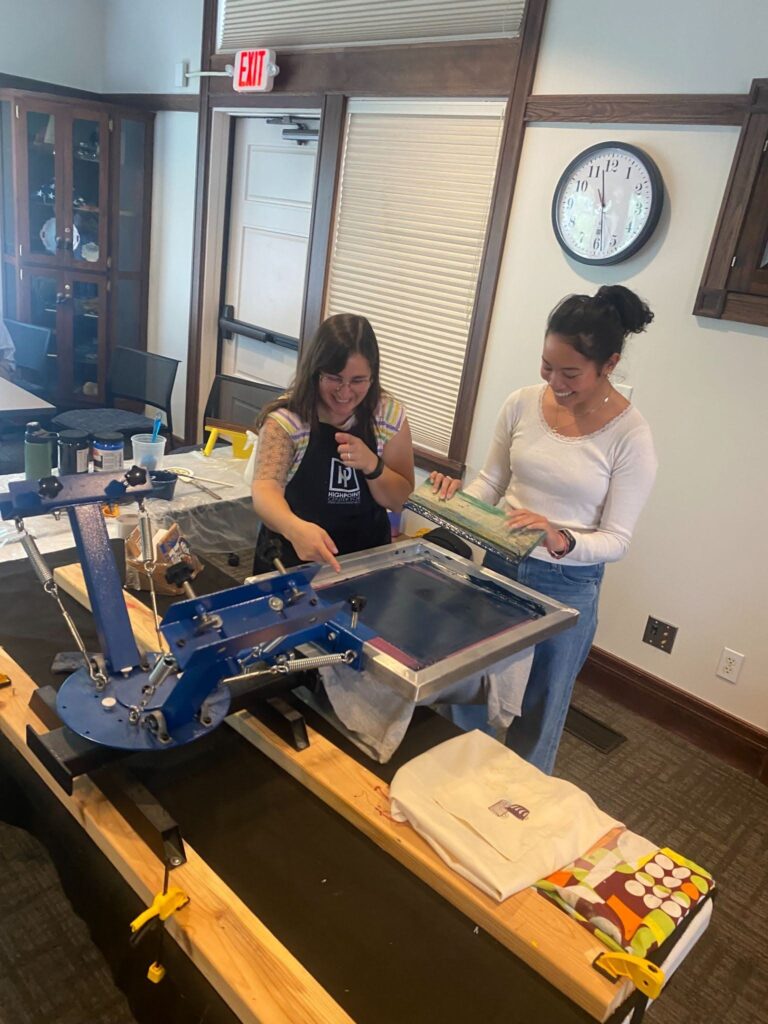
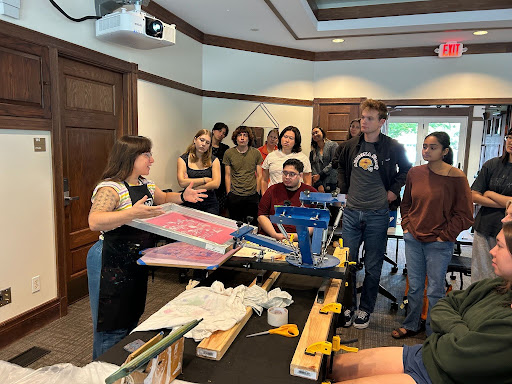
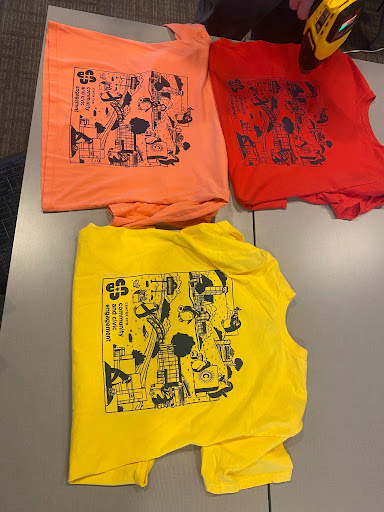
The Center for Civic and Community Engagement at Carleton College worked with two local artists to lead a printmaking workshop for students to print their own shirts with a design that referenced the intricate ecosystem of Rice County non-profits that their Center works with. As participants screen printed, there were squeals of delight when the screen revealed a beautiful print, with one student telling their friend, “This is the coolest thing I’ve ever done at Carleton!”.
At Macalester College, where Operation Metro Surge was a defining feature of the winter, students drew strong connections between creative expression and social change. There were countless examples of individual students, student-led organizations, and academic courses explicitly connecting art-making to activism. These initiatives reflected a broader cultural push throughout Minnesota to visualize and memorialize the devastating impact of ICE’s brutalizing violence on the social fabric.This often arts-infused work brought international attention to the issue and provided a template for other communities to mount a robust challenge to state violence and persecution.
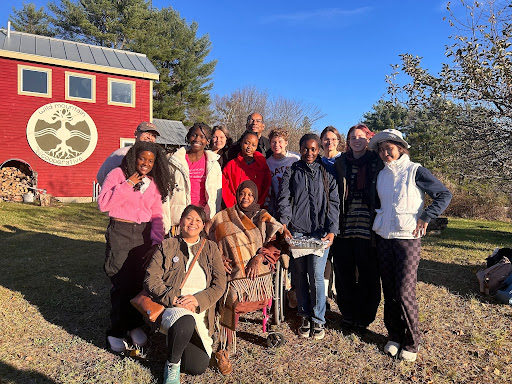
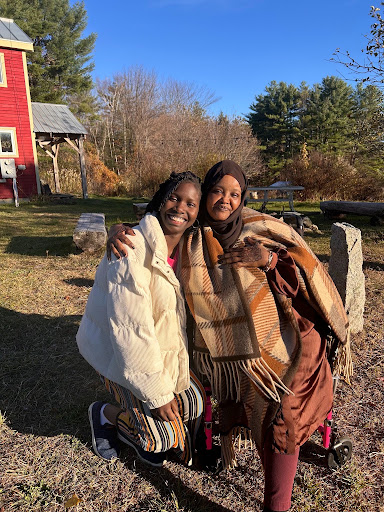
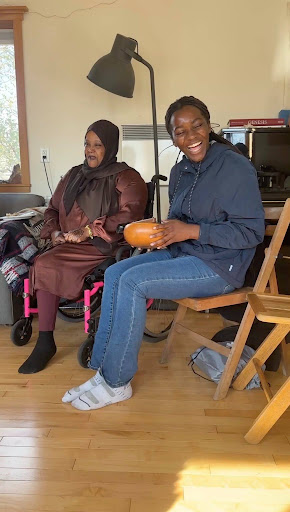
Last but not least, the Harward Center for Community Partnerships at Bates College collaborated with campus and community partners to host an intergenerational storytelling and art-making retreat. The retreat was generated after multiple conversations with students about the challenges of connecting with each other in response to national events, interests in intergenerational storytelling with community members and alumni, an interest in creative practice to support trauma healing and political resistance. The retreat was held at a cooperative living farm that serves as a gathering place for transformative organizing, teaching, and learning, and for imagining new land-based projects and ways of living. Participating partners and students left feeling inspired and connected and have asked if this activity could be done more often.
Where We Go From Here
In Outgrowing Modernity, Vanessa Machado de Oliveira writes about a process she names Gesturing Towards Decolonial Futures’ (GTDF), which involves depth inquiry – experimental and experiential spaces where participants can hold questions differently and support each other in a collaborative process of continuous learning and unlearning (Machado de Oliveira, 2025, xviii-xix). Such inquiry doesn’t magically free us from the complex challenges of the day, but it does serve as an invitation to embrace that complexity and confront our collective complicity in the current systems of harm with courage and imagination, so we can show up for each other “with more generosity and grace.”
The Creating Refuge Collaboratory participants, who have met continuously since January 2025 to engage in deep inquiry with each other, will continue our support of student civic engagement in increasingly challenging times for systems of democracy. In particular, we hope to embrace the power of the arts and storytelling to engage on our campuses and with our greater community with creativity and humility. We look forward to sharing more of our reflections and learnings with our campuses and with the Imagining America consortium in the future. In the meantime, here are some resources from our workshop at the 2025 IA Gathering, so you can learn more!
Funding has been provided by California Humanities and the National Endowment for the Humanities (NEH) as part of the American Rescue Plan Act of 2021.