African Migration is not One thing, so Let’s Rethink it Now
Chimee Adịọha
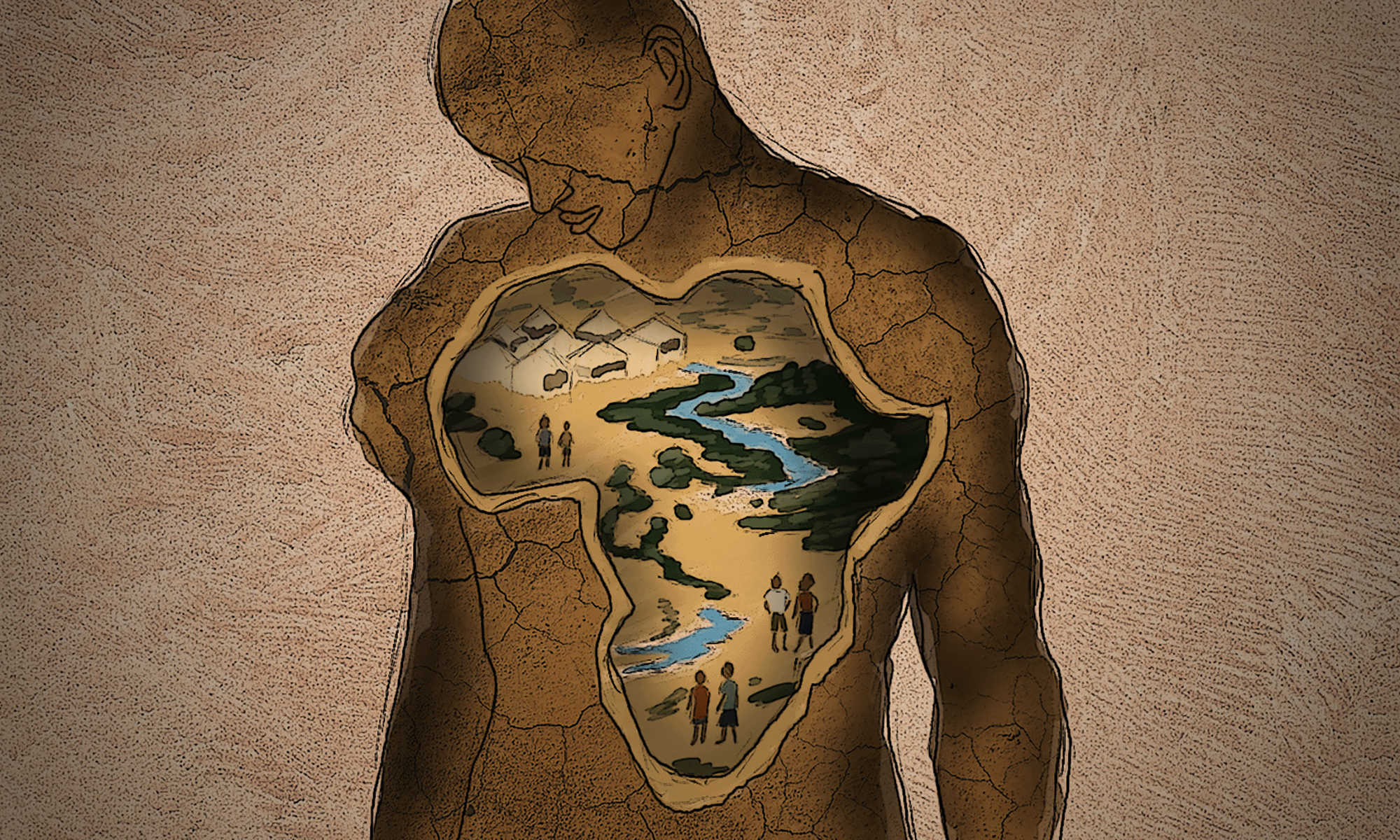
Original Artwork | Commissioned by Chimee Adịọha
In the summer of 2023, I had just moved from Texas, still with all the boxes I had arrived from Nigeria with. Then, in my new apartment in Southern California, I started creating Diaspora Africa with my friend in London. We had both grown up in Southeastern Nigeria, moved to Lagos in the same year, and joined a participatory photography documentary that reminded us of the non-monolithic definition of migration. It occurred to us that we had become adult migrants even while living in the same country, just after a 10-hour road trip or a 50-minute flight, without having to move abroad, although we would do so within the following five years. These phases of movement placed us under the “migrant” umbrella, both when we were within the country and now that we have moved outside the country, and even while moving within spaces outside the country. Diaspora Africa became our avenue to reframe migration in its most diverse forms. The media organization works with writers across Africa and its diaspora, using storytelling, research, media, and data to highlight all forms of mobility and our concerns about movement in contemporary Africa and beyond. The platform has recently focused more on narrative change, confronting information poverty, influencing more “aware” African migrant communities, and, most of all, decentering migration.
What Can We Learn?
Migrant justice need not borrow from the verbose definitions associated with the vast legal frameworks constantly shaping African migration. Africa requires a language of migrant justice that does not merely answer to the criteria of legality and numerous legislations but to human expectations; a language that incorporates not just the legal but also the lived practice that is the burden of mobility itself. What happens within these mobilities? What happens in the midst of these mobilities? Who bears the brunt of these mobilities? Who gets to move freely, and who gets trapped in an IDP camp (Internally Displaced Persons)? It is by raising these bothersome questions that we can begin to rethink existing focalizations and decide what serves us better: human needs or inaccessible legalese.
The continuous global criminalization of migration offers absurd hindrances to fair and safe mobility. In Africa, internal displacement would hardly form part of the thematic structures of migration because migration, in its African framing, exemplifies movement from the continent to the outside. What appears to be the dominant understanding is the possibility of moving for greener pastures and fulfilling the expectation of remittances and the “black tax,” an expected ritual required of every migrant leaving the shores of Africa. The attachment of a financial clause to the necessity of migration outside Africa, forming its capitalist basis, shifts popular attention away from the reality of internal displacement, which does not, in any form, serve a financial benefit.
The criminalization of migration, if it does not find its foundations in political bias, does not stem solely from social perception. Social perception, of course, contributes to how migration is viewed, but the force with which the political sphere defines migration does a disservice to its social reception, usually labeling migrants as criminalized subjects.
Amid this popular misunderstanding of the nuances of migration is the absence of knowledge, the failure to think of migration as dynamic, and the clear evidence of information poverty that never spotlights internal displacement as a migration issue but instead places the bulk of the discourse on movement outside the continent. While this happens, it creates negative opportunities for popular attention to focus on dialogues concerning passport inequalities, visa supremacy, and border politics, therefore leaving behind the urgencies within: the suboptimal realities of internally displaced people and the spaces they inhabit, especially within the African context.
What Exactly is Migrant Justice?
How can we rethink migrant justice using IDPs as a template? The Internal Displacement Monitoring Centre (IDMC) released a report on internal displacement at the end of 2024, providing an overview of the status of displacement across the world. A regional overview of Africa highlights Sudan, the Democratic Republic of the Congo (DRC), Somalia, Ethiopia, and Nigeria, categorized into IDPs displaced by conflict and violence and IDPs displaced by disasters. Totaling 34.8 million displaced people, IDPs displaced by conflict and violence account for 32.5 million people, led by Sudan, the Democratic Republic of the Congo, and Somalia. The number of IDPs has also risen from 11.4 million in 2014 to 34.8 million at the end of 2023, an increase of 23.4 million in less than a decade. It is noteworthy that while conflict and violence and disasters are two distinct factors contributing to internal displacement in Africa, there are cases in which these two factors overlap, as seen in countries such as Sudan, Ethiopia, and Kenya. In the DRC alone in 2023, conflict and violence were the primary drivers of the internal displacement of 3.8 million people. This was the second-highest figure recorded globally, after Sudan (IDMC).
Understanding Internal Displacements
There is a broad difference between an IDP and a refugee. One remains within the country, while the other crosses international borders. However, the major commonality between the two is the final residential structure that defines a significant part of their lives while seeking safety: a camp—”The temporary quarters, formed by tents, vehicles, or other portable or improvised means of shelter, occupied by a body of nomads or men on the march, by travelers, companies of sportsmen, lumbermen, field preachers and their audiences, or parties ‘camping out’; an encampment” (Oxford English Dictionary). I would identify “temporary” as the key word and relate it to the characteristics of an IDP camp. A UNHCR definition published in 2020 describes refugee camps as temporary makeshift settlements created to support people’s immediate and basic needs while also acknowledging that, once a person becomes a refugee, there is a high likelihood that they will remain displaced for many years, thereby challenging the notion of temporariness. Drawing from the dictionary definition and borrowing from UNHCR’s description of refugee camps, temporariness is the only meeting point between the two. Yet extended temporariness, like extended resilience, ceases to embody the very characteristics that define it as temporary. Thus, in IDP camps across Africa, particularly in the Democratic Republic of the Congo, which has one of the highest numbers of internally displaced persons, the possibility of temporariness has become increasingly distant and unattainable. An IDP camp that has existed for a decade or more, with growing needs among displaced populations affected by both conflict and disaster, demonstrates the unlikelihood of either eradication or temporariness. This is not to suggest that disasters will one day disappear, but rather that their existence, which is often temporary, should also determine their end.
Why Look Internally?
For Africa to rethink migrant justice, it must first look internally. By looking internally, its people and institutions need to acknowledge the widespread existence of IDP camps as central locations for migrant subjects. Such acknowledgment creates opportunities to address the shortcomings embodied by these camps, including the numerous reports on nutritional challenges among African refugee and internally displaced children, gender-based violence, the lack of basic amenities, illiteracy, and insecurity.
Migration, as an overarching and complex topic, must not restrict its scope to international movement alone but must also include the movement of people within the continent. In this way, legal frameworks that primarily serve international border politics can be decentered to also focus on internal displacement and advocate for laws and policies that guide, protect, and define the livability and survival of migrant subjects in Africa.
Funding has been provided by California Humanities and the National Endowment for the Humanities (NEH) as part of the American Rescue Plan Act of 2021.