Participatory Music, Sound Experiences, and Community Health
Ashley Martin-Casler
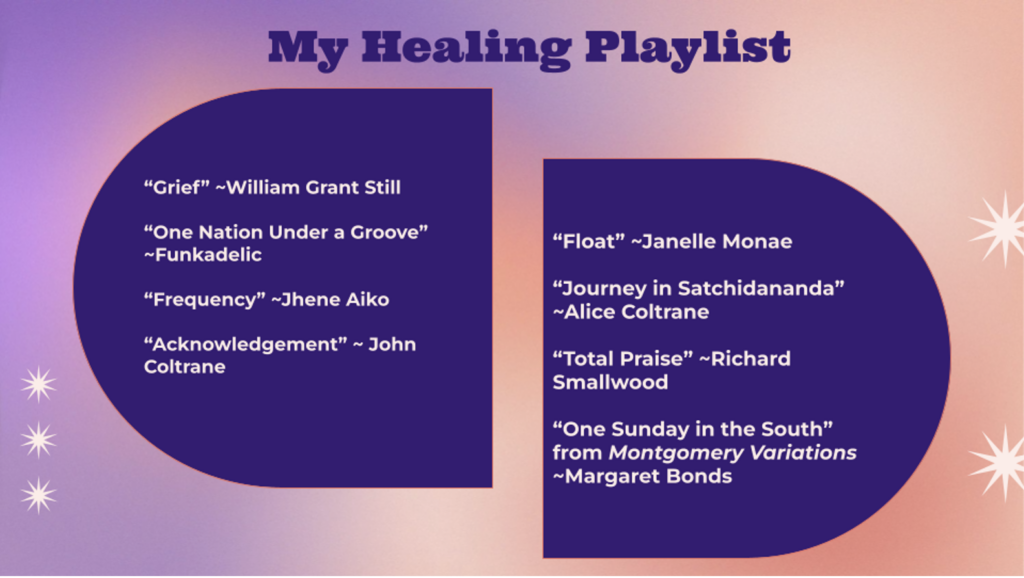
Though music is often a part of our daily lives, its potential as a vehicle for healing is less present as we go about our everyday routines. How often have we played a song to cheer ourselves up after a challenging work day, or added another track to our Sad Girl playlist when we feel due for a good cry? In our public consciousness, do we recognize music as a channel for emotional modulation, which can impact our sense of wellbeing?
As medical ethnomusicologist Benjamin Koen explains, “since music is affective and automatically effects change in the multi-dimensional complex that comprises a human being, its potential to be directly and more fully engaged to support health and well-being or facilitate healing transformations, is ever-present.” Exploring music’s inherent influence on our emotions, and thus, on our health/wellbeing, is at the core of my research interests as a PhD student in the Applied Intercultural Arts Research program at The University of Arizona. The Applied Intercultural Arts Research PhD program is an interdisciplinary degree where students combine the arts with diverse disciplines to tackle systemic issues facing our world. Through a medical ethnomusicological lens, I wish to explore how participatory music and sound experiences can be used as a tool for community mental health.
One in five adults in the US lives with a mental illness . In the wake of the COVID-19 pandemic, there have been increased rates of anxiety, depression, and overall psychological distress across the globe, with minoritized populations suffering disproportionately. Indeed, though Black adults report emotional distress at higher rates than whites, only one in three receive treatment. For African-American populations, one of slavery’s many afterlives is found in the social determinants of health. Education, employment, housing, and healthcare access are all affected by the construction of race, creating systemic barriers to health for Black people, especially low-resource populations.
In Tucson, AZ where I attend school, five percent of the population identifies as Black. The Pima County Health Department’s strategic plan for improved health throughout the county includes targeted areas such as increasing access to care and using innovative models for minoritized populations. This plan also includes increased access to behavioral health. These goals highlight community needs that my research seeks to address. There are many constraints African-Americans, particularly those with low resources, face when seeking behavioral healthcare, including stigma, cultural distrust, and cost/coverage. Yet African-Americans have modalities of healing that often go unrecognized in healthcare conversations. The importance placed on music in Black culture can provide deep insight into how this minoritized population in the United States has navigated extremely distressing conditions that increase vulnerability to premature death. As a Black woman musician, educator, and researcher, I hope to create collaborative mental health interventions using music/sound and vibrotactile stimulation as an innovative model that increases access to behavioral health for low-resource African-American populations.
Using Afrofuturism as a theoretical frame for my research design, I hope to, in the words of Afrofuturist theorist Ingrid LaFleur, “create alternate destinies for Black bodies.”
How can participatory music and sound experiences be used as a tool for Black community wellness? My research aims to explore this question through the lenses of Afrofuturism and health design, in an effort to provide passage to improved community mental health and longer, happier lives.
Funding has been provided by California Humanities and the National Endowment for the Humanities (NEH) as part of the American Rescue Plan Act of 2021.